
20,000 meals.3,500 bags.Five hours.
Youtopia is building modular Aggregation Centers that take chilled meals from local kitchens, sort them into customer bags and load them onto delivery vans every day. We're looking for the firms who will engineer, automate and supply them, across a planned network of more than 4,000 centers.
Shared at PACK EXPO International, Chicago, October 2026. This is not yet a formal call for proposals: the draft RFP is here so you can judge fit before we talk.
Why we're building this
Youtopia matches people with meals that fit their nutritional needs, prepared fresh by trusted local kitchens. Making that work nationally needs a fulfillment network that doesn't exist yet.
Each Aggregation Center receives meals from restaurant partners, identifies and sorts every one into a personalized order, packs it under temperature control and sequences bags for last-mile delivery, every day, in under five hours. Youtopia intends to build more than 4,000 of them across the US, serving a target market of more than 42 million consumers. Each is sized for up to 20,000 meals a day.
We want growth partners, not just equipment: firms who will help engineer, automate, manufacture, deploy and keep improving the network, from material handling, robotics and controls to refrigeration, modular construction, software, packaging, sensing and vehicles. Engage in one specialty, several related workstreams, or as an integrated solution partner.
The daily flow, with rates
What has to happen every day, whatever the design. Figures come from the Basis of Design; the ones marked indicative are our arithmetic, and your throughput model should replace them.
- 04:00–08:30
Pick-up
About 30 refrigerated cargo vans collect about 670 meals each from local kitchens, on reusable trays of 5–9 meals stacked 15 to a dolly.
~670meals a van, about 7 dollies - 08:30–09:30
Arrive and receive
20,000 meals on about 3,000 trays through four dock doors or fewer. Every meal is bulk-scanned against the expected inventory.
222–333meals a minute if unloaded over 60–90 minutes - From 08:30
Buffer
Absorbs the gap between the arrival peak and the line. Held in refrigeration with every meal still identified.
7,000–12,000meals waiting after the first hour, indicative - To mid-morning
Induct and identify
Each meal comes off its tray, level, and is positively identified. The hanging RFID tag comes off before the bag. The five-hour average is 67 a minute, but bags still have to be finished and loaded by 13:30, so induction realistically runs faster and finishes early.
130–220meals a minute to finish by 10:00–11:00, indicative - During induction
Sort to pods
Each meal goes to the pod holding its customer's bag. At container width, a 3,500-bag site needs about 10–15 pods.
13–22meals a minute into each pod at ten pods, indicative - Until the last meal lands
Pack
Every bag stays open until its last meal arrives, and is complete only when each expected meal is verified in it and nothing else is.
3,500bags open at once, about 300 per pod - As bags complete
Finish
Ice packs where requested (about two a bag), a tamper-evident liner seal, and a printed RFID bag tag read back to confirm it's on the right bag.
11.7+bags a minute, the five-hour average - By 13:30
Sequence and load
Bags put in van, route and stop order on carts that roll onto the vans and lock in place. Every van gone by 13:30.
19–23bags a minute through four doors over the last 2.5–3 hours, indicative - Evening and overnight
Returns
Vans bring back bags and ice packs. Bags are inspected; ice packs are inspected, sanitized and refrozen on carts of 100.
6,000ice packs a day, at most
Throughout: no meal outside refrigeration for more than 10 consecutive minutes at any transfer.
One candidate concept, in 3D
This model shows one way to meet the Basis of Design. It is not the required design, and where it differs from the RFP, the RFP governs. We'd rather hear a better idea than see this one copied.
Interactive 3D model
Drag to orbit, take the guided tour, and switch between morning and midday to watch the belt reverse.
Loads about 1 MB of 3D graphics.
What's fixed, and what this concept chose
| Topic | Fixed by the Basis of Design | This concept's choice (open in the RFP) |
|---|---|---|
| Rooms | 40 ft refrigerated containers at 35–40 °F, reached only through a window in one door (a purpose-built module is still open) | Rooms set side by side along a chilled spine |
| Dock and fleet | Four doors or fewer; about 30 vans shared between pick-up and delivery | Vans waiting their turn act as the surge buffer; the RFP's WP-02 asks for a buffer and welcomes this as an alternative |
| Identification | Bulk RFID scan at receiving; every meal identified before sortation; hanging tags removed before the bag | Tags come off in the identification room |
| Sortation | Each meal reaches the pod holding its customer's bag | One main conveyor along the pod doors, with a kicker at each pod |
| Packing | Bags presented on demand; placement verified meal by meal. Youtopia's working concept is a vertical put wall with robotic suction, and we welcome challenges to it | One robot per pod on an overhead rail |
| Finishing | Ice packs, tamper-evident liner seal and RFID bag tag on every bag | A finishing station inside each pod, by the door |
| Outbound | Bags in van, route and stop order; every van out by 13:30 | The cubby wall holds the sequence, and the main belt reverses at midday to carry bags back to the dock |
| Pod count | One at launch; the count is derived. About 10–15 at container width for 3,500 bags | The model shows up to ten |
What the model walks through
- About 30 shared vans arrive at four dock doors; vans waiting their turn stay plugged in and cold.
- Every meal is bulk-scanned by RFID against the expected inventory.
- Meals are inducted one at a time onto the main conveyor, kept level.
- Each meal is identified; its hanging RFID tag comes off before the bag.
- In this concept, a kicker at each pod door diverts the meal into its customer's packing room.
- Robotic suction places each meal into its customer's bag on a vertical put wall.
- Ice packs, a tamper-evident liner seal and an RFID bag tag finish each bag.
- In this concept, the put wall holds finished bags and releases them in van, route and stop order.
- In this concept, the main belt reverses and bags ride back to the dock, then onto carts in stop order.
- One warehouse management system runs it all and logs every meal, bag and temperature.
What we're sourcing
Mark what your company can do, or what you'd like to hear more about. Your picks collect at the bottom of the page and go to in one email. Pick anything: one specialty, several, or the whole system.
Requirements are written in RFP language (MUST, SHOULD, MAY) because they're drafted for the formal RFP. For now, read them as what a proposal will need to address; nobody is asking you to comply yet.
Automation work packages
In process order. Each holds its full requirements.-
WP-01
Receiving and de-tray
Take 20,000 packages off about 30 vans and present them singulated to sortation, inside 90 minutes of arrival.
Invitation scope areas in this package
Receiving & Induction System for Inbound Meals
Design intake of approximately 20,000 chilled meals per day from refrigerated vans, including scan/verification, inventory visibility, flow-rate control, buffering and controlled release to sortation. The fewer dock doors needed, the better. Meals will arrive on mobile, lightweight, durable, reusable, stackable trays. Meals will be in various tray/bowl packaging sizes and shapes, limited to 10" x 10" x 3" h, and weighing 2 lb or less.
Automated Tray Stacking/Storage
Develop the post-sort handling system for empty trays, including nesting/stacking, removal from the sorting room, compact storage and potential inventory visibility.
What a proposal will need to address 10 requirements
Governed by BOD-05, BOD-08, BOD-11, BOD-21, BOD-23, BOD-40 to BOD-42, BOD-50.
Input: loaded dollies rolled from a refrigerated van (BOD-42).
Output: singulated, upright packages presented to WP-03, plus empty trays to ambient staging.
Requirements
REQ-WP1-001MUSTAccept loaded dollies direct from the van (BOD-42).
REQ-WP1-002MUSTDe-stack trays and singulate their 5–9 packages, whatever their arrangement on the tray (REQ-PKG-010).
REQ-WP1-003MUSTHandle every package geometry in BOD-40 mixed on the same tray, within BOD-23.
REQ-WP1-004MUSTRead every package into an inbound manifest reconciliation against the van's expected inventory (REQ-COC-002).
REQ-WP1-005MUSTRoute empty trays to unrefrigerated staging, counted and attributed to the originating kitchen.
REQ-WP1-006MUSTHold packages within the exposure limit (BOD-21) across the entire receiving operation, including dock dwell.
REQ-WP1-007MUSTOperate through four dock doors or fewer, shared with outbound loading (BOD-38, REQ-FAC-005).
REQ-WP1-008SHOULDDetect and reject damaged, leaking or mis-oriented packages before they enter sortation.
REQ-WP1-009SHOULDSupport manual induction as a fallback at reduced rate when automation is down.
REQ-WP1-010MUSTNest or stack empty trays, remove them from the sorting area, store them compactly and keep a count of trays by kitchen (REQ-PKG-011).
What we want to see in your response
- Sustained and peak de-tray rate, in packages per minute, with the availability assumption.
- How you handle a tray whose packages have shifted in transit.
- Whether dollies enter a pod or stay in the warehouse, and the thermal consequence either way.
- Empty tray buffer size and how trays leave the building.
-
WP-02
Chilled surge buffer
Absorb the gap between a 90-minute arrival wave and a five-hour processing line.
What a proposal will need to address 6 requirements
Governed by BOD-05, BOD-08, BOD-11, BOD-12, BOD-20, BOD-35.
The inbound wave arrives in about an hour (BOD-05, BOD-11); sortation and packing run to the end of the production window (BOD-12). Something must hold the difference, in refrigeration, without losing package identity.
Input: singulated packages from WP-01, faster than the line can take them.
Output: packages metered into WP-03 at line rate.
Requirements
REQ-WP2-001MUSTBuffer capacity sufficient to decouple the arrival peak from sortation rate. State the capacity your design requires and show the queueing calculation.
REQ-WP2-002MUSTBuffered packages stay within BOD-20 for the full dwell.
REQ-WP2-003MUSTPackage identity is preserved through the buffer. A package entering and a package leaving must be the same known unit.
REQ-WP2-004MUSTMeter into sortation at a controllable rate.
REQ-WP2-005SHOULDSequence out of the buffer in an order that helps downstream — for example, releasing packages that complete nearly-finished bags first. State whether your design can do this.
REQ-WP2-006SHOULDDegrade gracefully: if sortation stops, the buffer should absorb inbound for a stated period before receiving must stop.
What we want to see in your response
- Buffer technology and why (shuttle, carousel, accumulation conveyor, tote-based AS/RS, something else).
- Enclosures and floor area consumed by the buffer, and the pod count at which it is first needed.
- Maximum dwell time and its effect on food quality.
- Whether buffering requires re-reading identity on exit, and the cost of that read.
Alternative worth arguing for
If you believe a buffer is the wrong answer — that receiving should simply run at 220+ packages per minute, or that pick-up routes should be staggered instead — make that case. Youtopia controls the pick-up schedule and can change it. Holding loaded vans, plugged in and locked, as the buffer is another option, and it is the one Youtopia's candidate concept shows. Section 16 asks the question directly.
-
WP-03
Identification and sortation
Read every package individually, resolve it to a household and a packing room, and divert it there.
Invitation scope areas in this package
Automated Package Identification & Sortation
Automate picking, identification and routing of variable meal packages from receiving to the correct refrigerated packing room, with rate control, buffering, exception management, and package-sequence logic. All functions other than conveyance happen inside of 40' refrigerated containers accessed by windows cut into one of the doors. No wall, ceiling, or floor penetrations.
Material Movement / Conveyor Systems Between Modules
Transport system for meal packages, bags and/or ice packs between receiving, buffers, sorting and packing rooms, with solutions appropriate to refrigerated container-based spaces and the defined material-flow strategy.
What a proposal will need to address 14 requirements
Governed by BOD-07, BOD-08, BOD-31, BOD-33, BOD-40, BOD-50, BOD-51.
Input: singulated packages from WP-01/WP-02.
Output: packages delivered to the correct packing room, identity confirmed.
Requirements
REQ-WP3-001MUSTRead the hanging UHF RFID tag on every package, individually attributable to that package (REQ-COC-005).
REQ-WP3-002MUSTResolve the package to its bag and packing room by lookup against the Youtopia platform. No data is written to the tag (BOD-51), which is encoded once at the kitchen.
REQ-WP3-003MUSTDivert to the correct packing room across the full room count your design requires.
REQ-WP3-004MUSTSustain the rate established under REQ-OPS-010.
REQ-WP3-005MUSTHandle a no-read deterministically: divert to a known exception lane, raise the event, and never pass an unidentified package downstream.
REQ-WP3-006MUSTReport a measured read rate and mis-read rate, distinguishing the two. A mis-read — reading tag B when package A is present — is materially worse than a no-read and must be reported separately.
REQ-WP3-007SHOULDProvide a secondary identification path (vision, barcode on the printed label) as cross-check or fallback.
The footprint and modularity problem
A sorter with a divert per packing room, running mixed unstable geometries with adequate gapping, is plausibly 60–100 ft of machine. A container is 36 ft long (BOD-34). The sorter does not fit in one room, and we do not have a preferred answer. Youtopia's candidate concept runs one main conveyor along the pod doors with a kicker at each pod; treat it as one option, not a requirement.
The options we can see are: span several containers, with transfers through 4 ft doors; place sortation in the warehouse outside the chilled rooms, which breaks REQ-XCT-001 and puts every package on the 10-minute clock; adopt a non-linear topology such as a two-stage or matrix sort; or enclose the pods in a chilled envelope (REQ-FAC-010).
Modularity decides between them. A single sorter with one divert per pod must either be bought at full size on day one and run at a tenth of capacity for years, or be extended every time a pod is added — which is exactly the rework Section 3 forbids. The architectures that survive the governing principle are:
- Two-stage sortation. Coarse allocation from receiving to a pod; fine sort to cubbie inside the pod. At one pod the first stage need not exist. At ten it is a small sorter with ten outputs, not a large one with thousands of destinations.
- Untethered transfer. AMRs, tugs or carts moving totes between receiving and pods rather than fixed conveyor. Adding a pod becomes a map update and a traffic lane, not construction. Under Option A this also avoids welding each container to a fixed spine through one of its two doors.
REQ-WP3-020MUSTState the physical length and footprint of your sortation solution and where it sits relative to the pods.
REQ-WP3-021MUSTIf sortation spans containers or sits outside them, show how REQ-FAC-002 and REQ-FAC-004 are satisfied at every transfer.
REQ-WP3-022MUSTAdding a pod must not require extending, re-engineering or re-commissioning shared sortation beyond configuration. State exactly what changes in your sort architecture when pod N+1 is added, and how long it takes.
The RF problem — read this carefully
The read environment is a refrigerated metal enclosure — a steel shipping container under Option A, typically a metal-skinned insulated panel room under Option B — with conductive surfaces on all six sides, producing severe multipath and unpredictable nulls. Tags are loose hanging paper/inlay tags, not bonded labels, so their orientation relative to the antenna is uncontrolled. Tag population density at the read point is high.
REQ-WP3-010MUST, if availableProvide a measured read and mis-read rate from a comparable enclosure — a metal-walled refrigerated space with a dense tag population. A vendor datasheet figure does not satisfy this. If you do not hold such data, say so plainly and request the RF trial described in Section 17; requesting it is not held against you, and claiming datasheet numbers as measured is.
REQ-WP3-011MUSTDescribe tag selection, antenna geometry, power and shielding strategy, and how you prevent stray reads from adjacent packages or an adjacent room.
REQ-WP3-012SHOULDPropose a tag specification if the current hanging tag is the wrong choice. The tag is not frozen.
REQ-WP3-013SHOULDState how read performance degrades with condensation, frost, and wet tags.
What we want to see in your response
- Reference site with item-level UHF RFID in cold, metal-enclosed space. Name it or describe it under NDA.
- Read architecture: portal, tunnel, overhead array, on-conveyor, handheld fallback.
- What happens to throughput when read rate drops below target.
- A proposed on-site RF survey and tag trial as a paid pre-contract work package, if you recommend one.
-
WP-04
Cubbie wall and bag presentation
Hold up to 3,500 chilled bags open simultaneously and present any one of them on demand. This package, not throughput, sets the size of the facility. Youtopia's working concept is a vertical put wall on each side of the room, with cubbies that present and hide bag positions on demand; challenge it if you have a better one.
Invitation scope areas in this package
Vertical Put Wall Cubby System for Bag Staging in Packing Rooms
Design a high-density vertical put-wall/cubby solution that presents and hides bag positions on demand, integrates with robotic and human packing, and maximizes usable capacity inside 36' x 7'6" refrigerated packing rooms. Because the room is insulated, wall, floor or ceiling penetration is not an option.
Automated Bag Loading to Cubbies Pre Meal Packing
Define the optimal pre-load process to prepare each cubby and thermal insulated bag, including bag presentation and when and how liner bags and ice packs will be inserted into the bag.
Automated Placement of Bag Liner in Delivery Bag
Define how the inner plastic liner is presented in the insulated bag, managed during packing and prepared for final closure and tamper-evident sealing.
What a proposal will need to address 13 requirements
Governed by BOD-02, BOD-03, BOD-20, BOD-22, BOD-31, BOD-34, BOD-43, BOD-44, BOD-55.
Why 3,500
Meals arrive unsorted from many kitchens across many vans. A household's bag cannot be closed until its last package arrives, and the last package may be on the last van. In the worst case every bag is open until the end of the sort. Youtopia's current position is that this worst case is the design case.
A rough sizing, offered as a starting point and not a requirement. The bag is 14 in high, 16 in long and 10 in wide (BOD-43), and which way it faces is worth roughly a quarter of pod capacity. Narrow face out, at about 12 in pitch, gives around 36 positions along a 36 ft wall but needs 16–17 in of depth; long face out, at about 18 in pitch, gives around 24 positions in 11 in of depth. At 5 tiers that is 120–180 cubbies per wall face. The enclosure then decides the rest. At container width there are two faces, 240–360 cubbies per pod, and 10–15 packing pods for 3,500 bags; ten pods falls short of 20,000 meals in most orientations. At 12 ft wide there are four faces, 480–720 cubbies per pod, and 5–8 pods. The ~300 and ~600 figures in Section 2 are midpoints of these ranges. Tell us if your numbers differ and why.
The aisle problem
The same arithmetic creates a difficulty we cannot resolve from our side. A room is 90 in wide internally. Cubbies 16 in deep on both walls leave 58 in. A feed conveyor takes another 18–24 in. That leaves roughly 34 in of working aisle — and the presented bag slides forward into it from both sides (REQ-WP4-002), while REQ-XCT-021 requires safe human access and egress in the same space.
Thirty-four inches does not accommodate a humanoid, and it may not accommodate much else. This problem is specific to the container. At 12 ft wide it does not arise — which is the strongest argument a module bidder can make against Youtopia's preference.
REQ-WP4-010MUSTProvide a dimensioned cross-section of your packing room showing cubbie depth, conveyor, working aisle, presented-bag travel and the egress path.
REQ-WP4-011MUSTIf the aisle does not close, say so and tell us what has to give: shallower cubbies, single-sided walls, a wider room, fewer bags per container, or a different pick architecture. This is the answer we most want from WP-04 bidders and we would rather hear it now than after award.
REQ-WP4-012MUSTHold the presented bag and its liner open for placement. The liner is pliable film and will collapse on its own. State the mechanism, whether it depends on the insulated bag being rigid enough to stand unsupported, and how the liner stays open through several placements as the bag fills.
REQ-WP4-013MUSTDefine the pre-load of each cubby: when and how the bag, its liner and, if your design loads them first, the ice packs go in before meals arrive.
Requirements
REQ-WP4-001MUSTSupport the concurrent open-bag count your design derives from Section 2. State the number and show the derivation.
REQ-WP4-002MUSTEach cubbie presents its bag to the pick position on demand and retracts to a ready state.
REQ-WP4-003MUSTBags stay within BOD-20 for the entire time they are open.
REQ-WP4-004MUSTDetect per-bag completion and signal that the household is ready to seal.
REQ-WP4-005MUSTFit within the pod envelope of Section 2 for the enclosure option you propose, including the working aisle and, under Option A, the access constraint of REQ-FAC-002.
REQ-WP4-006MUSTA cubbie fault must not strand its bag. State how a bag is recovered from a failed cubbie mid-shift.
REQ-WP4-007SHOULDSupport pre-staging of the night's bag plan, given contents are fixed 24 hours ahead (BOD-55).
REQ-WP4-008TBDBag and ice-pack replenishment into the cubbie wall is undecided. Propose a method (Section 16).
What we want to see in your response
- Cubbies per pod, and the layout drawing that achieves it.
- Total packing pod count at 20,000 meals/day, under the enclosure option you propose.
- Presentation mechanism and cycle time per present/retract.
- Completion-sensing method and its false-positive and false-negative rates.
- Capital cost per cubbie, since this number multiplied by 3,500 is likely the largest line in the project.
Cubbie turnover
Cubbie turnover is in scope as an option, and Youtopia wants it considered. The pod's job is to place bags in cubbies, pack them, and release them to loading; nothing requires a cubbie to hold one bag for the whole window. A bag that completes mid-window can be sealed, ejected and replaced by a fresh empty bag, so cubbies stop equalling bags. A bag whose meals all come from early vans completes early; one waiting on the last van completes late. At 30% turnover, 3,500 bags fit in roughly 2,450 cubbies. Turnover costs a bag-eject mechanism, a fresh-bag feed into every pod, and a scheduler to sequence it. How much turnover is available depends on the mix of producers and vans behind each bag, for which Youtopia has only planning assumptions until launch. Pod 1 will generate the real figure (REQ-RMP-013).
REQ-WP4-020SHOULDState whether your design supports cubbie turnover, the cubbie and pod count it saves, and what it costs. If your answer is that turnover does not pay at your cubbie density, show why.
-
WP-05
Pick, tag-strip and place
Take a package, remove its RFID tag, and place it in the right bag. Roughly 67 times a minute across every pod (BOD-07), in a chilled aisle — 7 ft 6 in wide in the preferred container.
Invitation scope areas in this package
Meal Accumulation, Identification, & Bag Packing
Design and build the modular refrigerated packing-room system including meal arrival through completed bag release, including buffering, bag/cubby presentation, exception handling, utilities and the division of human, robotic and control-system responsibilities. The room is a 40' refrigerated container, maintained at 35-40°F. We've envisioned a vertical put wall on each side of the room with automated cubbies using robotic suction to place meals in the appropriate bag and we welcome challenges to our thinking. No wall, ceiling, or floor penetrations.
Hanging Label Removal (meal packages)
Define and provide the automated process for removing hanging RFID meal tags from each meal package at the correct point between identification/sort and final bag packing.
Automated Ice Pack Packing into Bags
Define the placement method, human or robotic, for adding ice packs to each insulated meal bag. The ice packs are 13" x 9" x .75".
What a proposal will need to address 11 requirements
Governed by BOD-03, BOD-07, BOD-23, BOD-34, BOD-40, BOD-41, BOD-45, BOD-52.
Input: package delivered to a packing room by WP-03; a cubbie presented by WP-04.
Output: package in the correct bag, hanging tag removed if your design removes it here; bag marked complete when full.
Requirements
REQ-WP5-001MUSTConfirm package identity at the point of pick, before placement.
REQ-WP5-002MUSTWhere your design removes the hanging tag in the pick cell (BOD-52), separate it at the perforation without tearing the printed label, disturbing tamper tape, or damaging the package.
REQ-WP5-003MUSTCollect removed tags into bins at a defined handover point for disposal or recycling. Tags are single-use label stock printed at the kitchens and are not reclaimed.
REQ-WP5-004MUSTPlace the package into the presented bag, upright, without dropping or crushing. Bags typically take 3–10 packages, up to 14 lb including ice packs (BOD-03), and every assortment is unique.
REQ-WP5-005MUSTAdd ice packs per the consumer's request for that delivery (BOD-45, REQ-PKG-021). They are 13 × 9 × 0.75 in and 2.5 lb, and may go in before or after the meals, by robot or by hand; state which.
REQ-WP5-006MUSTHandle every package shape in BOD-40, from round bowls to rectangular trays, without a tooling change.
REQ-WP5-007MUSTWork within the pod aisle remaining after the cubbie wall and conveyance are installed.
REQ-WP5-008MUSTVerify placement — confirm the package actually entered the intended bag, not merely that it was released. This was a SHOULD in an earlier draft and has been promoted. Placement error is the dominant failure mode at the pick cell and the identification chain cannot catch it: the sortation read was right, the pick read was right, and the package still went into the wrong cubbie. Without this verification the detection guarantee in Section 14 is unachievable by construction. Price it as a MUST and show us the cost.
REQ-WP5-009SHOULDSupport manual operation at reduced rate when a cell is down.
The placement concept — challenge it
Youtopia's working concept is robotic suction placing each meal into its bag from a vertical put wall on each side of the room. It is a concept, not a validated design, and the placement method is the highest-cost and highest-risk decision in the program.
REQ-WP5-020MUSTState whether your design uses suction end-effectors as envisioned, another gripper, a gantry, a human operator, or something else — and defend the choice on cost, cycle time, reliability and maintainability.
REQ-WP5-021SHOULDIf you believe a different pick architecture would change the cubbie design (WP-04), say so. We would rather redesign the wall than build the wrong one.
What we want to see in your response
- Cycle time per pick, and picks per minute per cell.
- Cells required per packing room and in total.
- Tag-strip mechanism and its failure modes, with a measured success rate if you have one.
- Grip strategy across every package shape and material — in particular whether suction holds reliably on porous compostable fiber lids.
- Mean time between interventions, and who intervenes in a 35–40 °F room.
-
WP-06
Bag seal and labelling
Close every bag and label it with the household it belongs to — about twelve a minute, sustained (BOD-07).
Invitation scope areas in this package
Automated Internal Liner Bag Closure & Sealing
Provide a tamper-evident method to close and seal the internal plastic liner after meal placement, compatible with the refrigerated packing workflow and downstream bag handling.
Automated Bag Tag Label Placement System
Define the best trigger, print moment, on-bag location, and timing for printed customer bag tags, controls and integration with bag completion and staging as well as a reliable method for applying the correct bag tag to the correct completed delivery bag with absolute accuracy.
What a proposal will need to address 8 requirements
Governed by BOD-04, BOD-07, BOD-13, BOD-21, BOD-43, BOD-44, BOD-55.
Input: a completed bag signalled by WP-04.
Output: a sealed, labelled bag ready for cart build.
Requirements
REQ-WP6-001MUSTClose the interior liner with a tamper-evident closure. The liner is a pliable film bag; propose the closure method, whether heat seal, tie with a tamper band, or something else. The closure must show visible evidence if opened between the facility and the household.
REQ-WP6-002MUSTClose the insulated outer bag.
REQ-WP6-003MUSTPrint, RFID-encode and apply a 2 × 6 in bag tag (BOD-46) carrying consumer name, delivery address, route and stop, and the bag's position in its household group (for example, 2 of 3) so the driver knows how many bags belong at the door.
REQ-WP6-004MUSTThe bag tag is applied so it survives handling, cold and condensation, and remains legible at the doorstep.
REQ-WP6-005MUSTReconcile bag contents against the expected inventory before sealing. A bag that is short must not seal silently (REQ-COC-003).
REQ-WP6-006MUSTSealing happens inside the refrigerated envelope, or within the exposure limit (BOD-21).
REQ-WP6-007SHOULDCapture a record of the seal event: time, cell, operator or machine, and the final content list.
REQ-WP6-008MUSTThe bag tag carries both RFID and a barcode (BOD-46). Read both back after application to confirm the right tag is on the right bag.
What we want to see in your response
- Sealing mechanism and cycle time, and whether one cell serves several packing rooms or each room has its own.
- Print-and-apply hardware, and its reliability at 35–40 °F with condensation present.
- Label stock and adhesive suited to cold and wet.
- What happens to a bag that fails reconciliation: held, diverted, sealed-and-flagged.
Dependency
Route and stop are not known until after the last pick-up scan (BOD-55). Bag tags therefore cannot be pre-printed the night before. State how quickly your print queue can absorb the route file once it lands, and whether that is on the critical path to 13:30.
-
WP-07
Cart build and van load
Get every sealed bag onto its van in stop order (BOD-06), with every van gone by 13:30 (BOD-13).
Invitation scope areas in this package
Outbound Staging & Van Loading
Develop a refrigerated staging and loading system for up to 3,500 completed bags (typically 2,500–3,300), sequenced by delivery route and loaded onto roughly 30 vans through four or fewer dock doors by the dispatch deadline. Temp-controlled rooms are 40' refrigerated shipping containers with interior dimensions of 36' x 7'6".
What a proposal will need to address 10 requirements
Governed by BOD-02, BOD-04, BOD-06, BOD-13, BOD-21, BOD-43.
Input: sealed, labelled bags from WP-06.
Output: loaded vans, reconciled against their route manifests.
Requirements
REQ-WP7-001MUSTPlace each bag at a designated position on a designated route cart. Position is determined by delivery stop order.
REQ-WP7-002MUSTLoad carts into vans sequentially and in designated positions, so a driver reaches the next stop's bag without searching.
REQ-WP7-003MUSTReconcile every bag onto its van against the expected route manifest before the van departs.
REQ-WP7-004MUSTComplete every van load by the departure deadline (BOD-13), with the last bag sealed no later than your stated cut-off.
REQ-WP7-005MUSTRespect the exposure limit (BOD-21) during cart movement and van loading, including time on the dock.
REQ-WP7-006MUSTSupport the return flow: receive used bags and ice packs back from drivers, count them, and route bags to inspection and Youtopia's wash partner and ice packs to inspection, sanitization and freezing. Washing is out of scope; receiving, counting, inspection and the ice-pack system are in scope (Section 13).
REQ-WP7-007SHOULDHandle a late-arriving bag — one completed after its cart has left the packing area — without breaking sequence.
REQ-WP7-008TBDWhether bags are scanned onto carts, onto vans, or both is undecided. See Section 16.
REQ-WP7-009MUSTA household's bags are placed together on the same cart, in adjacent positions, and loaded to the same stop (REQ-COC-011). A cart must not leave loading with part of a household's bags. State how your design holds a cart when one bag of a group is late.
REQ-WP7-010MUSTCarts roll onto the van fully stocked and are secured for transit without blocking the driver's aisle (BOD-39, BOD-47). State how many carts and bags each van takes in your design.
What we want to see in your response
- Cart design and capacity, or a statement that you would use a cart we supply.
- Whether carts are built in the packing room, a loading room, or on the dock.
- Whether Receiving and Loading can share one room in your design (Section 16).
- Load time per van, and how many vans you can load in parallel.
- Dock door count and the marshalling area required.
Constraint reminder
Under Option A, a cart built inside a container room has to leave through a 4 ft doorway that may already carry a conveyor cut-out (REQ-FAC-002). Cart width and the room's remaining clear opening are a coupled decision. State both. Youtopia's candidate concept sequences finished bags in the cubby wall and returns them to the dock on the same main conveyor, reversed once the last meal is inducted. State whether your design shares conveyance between inbound and outbound and, if it does, how a meal that arrives after the switch reaches its bag.
-
WP-08
Controls, integration and data
One warehouse management and controls layer across every pod, integrated with the Youtopia platform. We own orders, routing and consumer state. You own the floor.
Invitation scope areas in this package
Warehouse Management System / Controls / Tracking
Provide the WMS and controls layer that orchestrates receiving, sorting, bagging and movement, maintains real-time package location and status, manages exceptions and creates end-to-end traceability.
Temperature Tracking of Environments
Provide cold-chain monitoring for pickup, transport, receiving, packing and staging, supporting meal acceptance checks and continuous or scheduled environmental temperature records within the operating range.
What a proposal will need to address 15 requirements
Governed by BOD-51, BOD-53, BOD-54, BOD-55, BOD-56, BOD-60.
Platform context
Youtopia runs on .NET on Azure, event-driven, with Azure SQL and Cosmos DB, deployed through Azure DevOps (BOD-56). We will expose and consume versioned APIs and an event stream; we are not asking you to adopt our stack internally.
Requirements
REQ-WP8-001MUSTA single warehouse management system (WMS) and controls layer spanning all rooms and work packages, including any equipment supplied by another vendor.
REQ-WP8-002MUSTConsume from Youtopia: the bag plan (BOD-55), the expected inventory per step, the route and stop assignment (morning), and consumer-level ice-pack requests.
REQ-WP8-003MUSTEmit to Youtopia, in real time: every scan event, every reconciliation result, every exception, and every state change of a bag.
REQ-WP8-004MUSTException events must carry enough context for Youtopia to act — package ID, expected location, actual location, step, timestamp, and the reason class.
REQ-WP8-005MUSTVersioned API contracts in both directions, with a documented deprecation policy.
REQ-WP8-006MUSTOperate degraded when the link to Youtopia is down: continue processing against the last known plan, queue events, and reconcile on reconnect. State the maximum offline duration you support.
REQ-WP8-007MUSTProvide an operations view showing live throughput, queue depths, open bags, exceptions and projected completion against the 13:30 deadline.
REQ-WP8-008SHOULDRetain a full event history per package and per bag, queryable, for at least 90 days.
REQ-WP8-009SHOULDSupport a simulation or replay mode so Youtopia can test route and volume changes before they hit the floor.
REQ-WP8-010MUSTRecord room, staging and dock temperatures continuously and link them to each meal's and bag's event history, supporting acceptance checks at receiving.
Security and data
Bag tags carry consumer names and delivery addresses, and bag contents are derived from a nutrition plan. Treat all of it as personal data.
REQ-WP8-020MUSTEncrypt personal data in transit and at rest. State your key management approach.
REQ-WP8-021MUSTRole-based access control with audit logging on any access to consumer data.
REQ-WP8-022MUSTNo consumer data leaves the facility network or your named cloud region without explicit contractual permission.
REQ-WP8-023SHOULDState your security certifications (SOC 2 Type II, ISO 27001) and your last penetration test date.
REQ-WP8-024SHOULDDescribe how you would support a consumer data deletion request reaching your systems.
What we want to see in your response
- A real API contract from a previous WMS-to-customer-platform integration, redacted as needed.
- Your integration model: REST, event bus, file drop, or a mix.
- Who owns the integration work and how it is priced.
- Whether the WMS is yours, licensed, or third-party, and what happens to it if we part ways.
Everything else we're sourcing
48 scope areas in all, from the Solution Provider Invitation.Integration and software
Master System Designer/Integrator
Serve as the overall integration partner responsible for turning the vision into a coordinated end-to-end operating system, aligning specialist providers, controls, interfaces, material flow, commissioning and performance.
Routing Software for Pickup & Delivery
Provide routing technology which integrates with the order system to optimize pickup and delivery routes against time windows, with real time locator, proof of delivery and ETA notifications.
Employee Scheduling Software
Including shift scheduling per role, employee documentation, GPS tracking by log-in, missing shift remediation, and sign out of assets (ie: keys, RFID scanners, infrared temp scanners, delivery routes handhelds).
Scan-Compatible Inventory Tracking Software
Scan inventory against expected using RFID or printed code, raise variances, populate next stage expected inventory and repeat through the delivery chain. Integrate with our ordering system and routing software, becoming the back end of all scan processes.
Facility, dock and containers
Dock Ramp Leveling
Bridge or level refrigerated vans to receive/load dock height for timely and efficient movement of tray dollies and bag carts on/off vehicles.
Dock Weather Protection
Provide dock-to-van protection that limits temperature exposure during product transfer and fits the contemplated high-roof refrigerated cargo-van fleet. Includes temporary attachment to leased warehousing.
Electricity Management
Overall management including load calculations for facility launch and growth, commercial grade physical updates, managing connectivity for various automated components, ensured readiness for scale up and execution at all times, including an emergency mitigation system.
Facility Management
Ongoing management of equipment reliability and the facility environment, including but not limited to cleanliness, preventive maintenance, spare parts, lubricants, cleaning agents, safety systems, restrooms, pest control and required documentation.
Leased Refrigerated Containers- Modular Rooms
Provide or integrate 40' refrigerated shipping containers used as modular receiving, packing and staging rooms operating within the required chilled temperature range of 35-40°F, and capable of scaling by adding or removing modules.
Labels and printers
Thermal Transfer Printable Labels, non-RFID
Supply preformatted, branded, 4" x 2" thermal transfer labels for meal packages for on-demand printing at partner kitchens. 1" core for tabletop printers.
Thermal Transfer Printable RFID Labels - for Meal Packaging
Supply preformatted, branded, three-part, thermal transfer printable labels with uncoded RFID label stock supporting plating instructions, package identification and a perforated, removable hanging RFID tag, with adhesives suited to refrigeration and microwave exposure. 4" wide label stock on 1" or 3" core. Label sections are 2", 2" and 1" separated by perforation.
Thermal Transfer RFID Bag Tag Labels
Supply 2" width x 6" length bag-tag labels for thermal transfer (think airline bag tags, only shorter), ready for print-on-demand plus RFID encoding and barcode printing.
Tamper-Evident Labels & Seals
Supply pre-printed, branded tamper-evident labels for meal packages and inner bag liners that perform reliably under refrigeration and, where applicable, microwave exposure.
Thermal Transfer RFID Printers
Provide tabletop print-on-demand thermal transfer with RFID encoding for partner kitchens, including hardware, ribbons and three-part label printing/encoding capability. 4" label stock on 1" or 3" core. Wi-Fi, Bluetooth and USB capable. Minimum 3-year maintenance warranty.
Thermal-Transfer Label Printers, non-RFID
Supply compact tabletop kitchen printers for on-demand 4" x 2" labels with Wi-Fi, Bluetooth and USB connectivity and compatibility with 1"core roll stock. Minimum 3-year maintenance warranty.
Thermal Transfer ‘Bag Tag’ Label Printers
Provide thermal transfer printers capable of RFID encoding for 2" wide by 6" length bag tags which will be applied airline-style to the exterior of thermal insulated delivery bags.
Packaging, trays, bags and carts
Compostable Meal Containers
Cost-effective, tariff-resistant containers targeting rapid post-use composting, must maintain five-day refrigerated-with-food performance, microwave compatibility, stable bases, secure lids, label adhesion and a high-quality appearance. Must perform under refrigeration and microwaving; freezing and oven-ability a plus. No petroleum-based plastics; compostable fiber or plant-based PLA is accepted.
Stackable Meal Package Carrying Trays
Durable, reusable trays optimized for meal transport considering capacity, stack/nest, carrying, rolling, sanitation, and movement through cold food-production spaces, doors and refrigerated vans. Current trays typically carry 5-9 meals. Trays will be stacked, rolled onto/off vans and secured while in transit. Van dimensions are 146" x 68", and drivers must have aisle access from rear door to bulkhead door while trays are stacked in van. Trays will be moved in/out of restaurant walk-in coolers.
Dollies for Stackable Meal Trays
Durable, maneuverable, and storage-efficient dollies matched to the meal tray system, optimized for kitchens, human doors, refrigerated vans with internal cargo space of 146" x 68", and Aggregation Center handling.
Thermal Insulated Meal Delivery Bags
Lightweight, collapsible, thermal insulated, branded, and stain-resistant reusable bag compatible with cubbies, meal packages, ice packs, bag tags, carts, and potential robotic handling. Could be placed, packed, and closed robotically or by humans. Typical capacity is 3-10 meal packages and up to 14 lb including ice packs. Bag must fit on bag carts which will be rolled onto refrigerated vans. Dimensions approximately 16" l x 10" w x 14" h. Open to design ideas compatible with automated packing.
Mobile Bag Carts - inner facility and van loading
Metal carts optimized for delivery bag transport inside Aggregation Center and refrigerated vans with a cargo dimension of 146" x 68" by 71" h. Carts will hold thermal insulated bags containing meals. Carts will roll on to vans completely stocked in delivery stop order, with specific bags in specific locations. Carts will be secured so they won't shift or tip during transport, and though space will be limited, carts will not impede mobility while driver is in the cargo area during deliveries.
Refrigerated vans
Refrigerated Cargo Van Upfitting
Upfit an extended wheelbase, high-roof cargo van to include refrigeration, insulated lining, a bulkhead door, and potentially a rear lift, capable of securing and transporting mobile tray stacks of meals and meal delivery bag carts, maintaining a cargo temp of 35-40°F across multiple stops in varied and sometimes extreme weather.
Refrigerated Van Fleet Maintenance
Provide ongoing mechanical and refrigeration maintenance programs capable of supporting hundreds of refrigerated vans per market.
Refrigerated Van Fleet Leasing
Offer fleet financing structures that reduce upfront capital requirements while supporting deployment and growth of the refrigerated vehicle fleet.
Cart Securing in Van
Provide a practical restraint system that secures 70" high metal carts (and bags on them) inside refrigerated vans while supporting rapid loading, unloading and driver access to cargo during deliveries.
Ice packs and returns
Reusable, Chem-Free Ice Packs
Supply durable, reusable, watertight ice packs optimized for fast freezing and airflow, within the target dimensional and weight envelope, with competitive cost and scalable lead times.
Ice Pack Freezing System
Engineer an efficient, modular, high-throughput freezing solution supporting staggered FIFO operations supplying up to 6000 reusable, 2.5 lb water-filled ice packs daily, including BTU capacity, airflow, cart handling and recovery time.
Ice Pack Carts
Design rolling airflow carts carrying 100 reusable ice packs per cart, balancing freezing/heat extraction performance, ergonomic handling, durability and safe movement through the facility. The ice packs are 13" x 9" x .75".
Ice Pack Inspection (inbound)
Develop an inbound inspection method for returned reusable ice packs to identify contamination, cracks, leaks or other conditions requiring removal from service.
Ice Pack Sanitization (inbound)
Provide a food-safe, scalable sanitization process for returned reusable ice packs that removes microbial risk without leaving an unsafe or objectionable contact surface inside delivery bags.
Ice Pack Transfer & Inventory
Design tracking system connecting inbound/outbound inventory, inspection, sanitization, freezing and packing rooms, with real-time awareness of available inventory and pack demand by room.
Returned Bag Inspection
Develop a fast, repeatable inspection process for returned delivery bags, checking interior and exterior condition, cleanliness, tears, staining, branding damage and disposition into good/rework/retire categories.
Scanning
RFID Scanners, handheld and/or fixed
Provide handheld and bulk-reading RFID capability for kitchen, driver and Aggregation Center workflows, including recommendations for frequency, read distance and operational configuration.
Basis of Design
This section is the single statement of the facts every design must meet. Work packages cite these items by ID rather than restating them. If a figure changes, it changes here and nowhere else.
Youtopia is pre-launch, so not every figure is a measurement. Each item carries a status:
| Status | Meaning |
|---|---|
| Fixed | Binding. Design to it; a design that breaks it is not viable. |
| Assumed | A planning assumption. Design to it, show how sensitive your design is to it, and expect it to be revised once pod 1 is running. |
| Derived | Calculated from other items. The arithmetic is shown at the end of this section; tell us if it is wrong. |
| Open | Not decided. Section 16 asks for your recommendation. |
The Governs column shows which work packages each item binds.
Volume and throughput
| ID | Fact | Value | Status | Governs |
|---|---|---|---|---|
| BOD-01 | Meal packages per day, per site | 20,000 | Assumed | All |
| BOD-02 | Bags per day | Up to 3,500; typically 2,500–3,300 | Assumed | WP-04, WP-06, WP-07 |
| BOD-03 | Meals per bag | Typically 3–10, up to 14 lb per bag including ice packs; all bags one size | Fixed | WP-04, WP-05 |
| BOD-04 | Bags per household | One or more; a household's bags are tracked, loaded and delivered as one group | Fixed | WP-06, WP-07, WP-08 |
| BOD-05 | Inbound | About 30 refrigerated vans, about 670 meals each | Assumed | WP-01, WP-02 |
| BOD-06 | Outbound | The same vans, about 85–120 bags each | Assumed | WP-07 |
| BOD-07 | Average line rate | 67 packages and up to 11.7 bags per minute | Derived | WP-03 to WP-06 |
| BOD-08 | Inbound peak | 222–333 packages per minute, depending on the unload profile | Open (Q9) | WP-01 to WP-03 |
Schedule
| ID | Fact | Value | Status | Governs |
|---|---|---|---|---|
| BOD-10 | Operating days | 7 per week; no weekly shutdown | Fixed | All |
| BOD-11 | Inbound docking | All vans between 08:30 and 09:30 | Assumed — Youtopia can stagger pick-up routes | WP-01, WP-02 |
| BOD-12 | Production window | 08:30–13:30, five hours | Fixed | All |
| BOD-13 | All delivery vans departed | 13:30 | Fixed — hard deadline | WP-06, WP-07 |
| BOD-14 | Non-production window | ~19 hours overnight, shared by sanitation, bag returns, restocking, maintenance and pod installs | Derived | All |
Temperature and food safety
| ID | Fact | Value | Status | Governs |
|---|---|---|---|---|
| BOD-20 | Product temperature | 35–40 °F at all times inside the facility | Fixed | All |
| BOD-21 | Exposure limit | No more than 10 consecutive minutes outside refrigeration, per exposure; not cumulative | Fixed — measurement method open (Q11) | All |
| BOD-22 | Bag temperature at packing | Pre-chilled to 35–40 °F | Fixed | WP-04 |
| BOD-23 | Package handling | Upright throughout; tamper tape never disturbed | Fixed | WP-01 to WP-05 |
| BOD-24 | Warehouse ambient outside the pods | 60–100 °F; the winter minimum depends on whether the building is heated | Open | All |
Pod and site
| ID | Fact | Value | Status | Governs |
|---|---|---|---|---|
| BOD-30 | Unit of capacity | An identical, self-contained, refrigerated packing pod | Fixed | All |
| BOD-31 | Pods per site | 1 at launch; the count at 20,000 meals a day is the bidder's to derive | Assumed | WP-03, WP-04, WP-08 |
| BOD-32 | Adding a pod | Roughly quarterly, without stopping production or reworking anything shared | Fixed | All |
| BOD-33 | Pod enclosure | Shipping container (preferred) or purpose-built module | Fixed preference — module open (Q14) | All |
| BOD-34 | Pod internal dimensions | Container: 36 ft L × 7 ft 6 in W × 8 ft 4 in H, reached only through windows cut into one door; no wall, ceiling or floor penetrations. Module: bidder-specified, ~12 ft wide suggested | Fixed for container — open for module | WP-04, WP-05 |
| BOD-35 | Minimum viable site | 1 pod, shared receiving and loading, and provision for a surge buffer added later | Fixed | All |
| BOD-36 | First site | South Denver near Centennial, Colorado; ~5,800–5,900 ft elevation; building not yet selected | Fixed | All |
| BOD-37 | Network | More than 4,000 standalone centers planned across the US, each served by local kitchens and sized for up to 20,000 meals a day; target market of more than 42 million consumers | Assumed | All |
| BOD-38 | Dock | Four dock doors or fewer, shared by arrivals and departures, with levelling to van floor height and weather protection between dock and van | Fixed | WP-01, WP-07 |
| BOD-39 | Vehicle | Extended-wheelbase, high-roof refrigerated cargo van; cargo space 146 × 68 × 71 in held at 35–40 °F, with a bulkhead door and a driver aisle from the rear door to the bulkhead | Fixed | WP-01, WP-07 |
Product, packaging and consumables
| ID | Fact | Value | Status | Governs |
|---|---|---|---|---|
| BOD-40 | Meal packages | Compostable fiber or plant-based PLA tray and bowl shapes up to 10 × 10 × 3 in; microwave-safe; no petroleum-based plastics | Fixed — packaging is being sourced in parallel | WP-01, WP-03, WP-05 |
| BOD-41 | Package weight and closure | Up to 2 lb; closed but not watertight; tamper-evident label across the closure | Fixed | WP-01, WP-05 |
| BOD-42 | Tray and dolly | Reusable stackable tray, about 22 × 26.5 in, carrying 5–9 mixed meals; up to 15 trays per wheeled dolly of about 22.75 × 27 in | Fixed — tray design and arrangement open | WP-01 |
| BOD-43 | Insulated bag | 16 in L × 10 in W × 14 in H; lightweight, collapsible, reusable; inspected on return | Fixed | WP-04 to WP-07 |
| BOD-44 | Liner | Plastic film liner inside the insulated bag; tamper-evident closure | Fixed — insertion timing and closure method open | WP-04 to WP-06 |
| BOD-45 | Ice packs | Reusable, water-filled, chemical-free; 13 × 9 × 0.75 in, 2.5 lb; up to 6,000 a day at about two per bag; frozen on carts of 100 | Fixed — placement timing open | WP-05 |
| BOD-46 | Bag tag | 2 × 6 in thermal-transfer label, RFID-encoded and barcoded, printed on demand and applied airline-style to the outside of the bag | Fixed | WP-06, WP-07 |
| BOD-47 | Bag cart | Metal cart about 70 in high, stocked in delivery stop order, rolled onto the van and secured in transit | Fixed — cart design open | WP-07 |
Identification, data and accuracy
| ID | Fact | Value | Status | Governs |
|---|---|---|---|---|
| BOD-50 | Identifier | Three-part 4 in label printed and RFID-encoded at the kitchen: plating instructions, package identification, and a perforated, removable hanging RFID tag | Fixed | WP-01, WP-03, WP-05 |
| BOD-51 | Writing to the tag | Never. The tag is an identifier; all state lives in the Youtopia platform | Fixed | WP-03, WP-08 |
| BOD-52 | Tag removal | Between identification and final bag placement, at a point the bidder defines; tags are single-use | Open | WP-03, WP-05 |
| BOD-53 | Reconciliation | Every handoff reconciles a physical read against an expected inventory | Fixed | All |
| BOD-54 | Exception latency | 2 seconds from detection to Youtopia | Fixed — bidders may propose another figure | WP-08 |
| BOD-55 | Bag plan timing | Contents fixed at least 24 hours ahead; route and stop assigned the morning of, before the vans dock | Fixed | WP-04, WP-06, WP-08 |
| BOD-56 | Platform | .NET on Azure, event-driven; versioned APIs in both directions | Fixed | WP-08 |
| BOD-60 | Accuracy | No defective bag leaves the building. Faults will happen; every one is detected and flagged before the van doors close | Fixed | All |
The enclosure: container preferred
Youtopia's preferred enclosure is the leased refrigerated shipping container. It is a commodity with an established lease and resale market, it moves on standard transport, it deploys quickly, and it can be folded up and relocated if a market underperforms. Design to it first.
The purpose-built insulated-panel module stays open for one reason: width is where capacity lives, and no ISO container is wider than about 7 ft 8 in internally. A bidder proposing the module must show what it buys against the container — fewer pods, a lower cost per bag, a workable aisle, or better reliability.
| Option A — shipping container (preferred) | Option B — purpose-built module | |
|---|---|---|
| Internal width | 7 ft 6 in, fixed by ISO standard | Bidder-specified; ~12 ft suggested |
| Cubbie faces | 2 (both long walls) | 4 (two walls plus a double-sided centre rack) |
| Est. cubbies per 36 ft pod | ~300 | ~600 |
| Packing pods for 3,500 bags | ~10–15 | ~5–8 |
| Wall penetrations | Not permitted — leased | Wherever the design needs them |
| Doors | Two 4 ft, front end only | Bidder-specified |
| Relocatability | High — standard transport | Moderate — factory-built, redeployable |
| Supply and resale market | Established, commodity | Limited |
The consequence of the preference, stated plainly: at container width, 20,000 meals a day needs roughly 10–15 packing pods depending on how bags face in the cubbie wall (Section 8), at or beyond the ten or so Youtopia has been planning around. At 12 ft wide it needs roughly 5–8. Tell us the pod count your design needs; do not design to a pod count.
For reference, the container envelope:
| Dimension | Value |
|---|---|
| Internal length | 36 ft |
| Internal width | 7 ft 6 in |
| Internal height | 8 ft 4 in |
| Internal floor area | ~270 sq ft |
| Doors | Two hinged, 4 ft each, at the front end |
| Cooling unit | Rear wall, opposite the doors |
How the derived figures are calculated
- Line rate (BOD-07). 20,000 packages and up to 3,500 bags across the 300-minute production window gives 67 packages and 11.7 bags a minute — one finished bag about every 5 seconds. The last bag must seal early enough to be loaded before 13:30, so the real outbound rate is higher.
- Inbound peak (BOD-08). 20,000 packages arrive between 08:30 and 09:30. Unloaded evenly across that hour that is 333 a minute; spread across 90 minutes, 222. The profile has not been measured and it sizes WP-01 and WP-02.
- Bag count (BOD-02). Bag capacity is set by weight and volume, not by a meal count. The 14 lb limit includes ice packs, and two ice packs weigh 5 lb, so an iced bag carries at most about 9 lb of meals; a 16 × 10 in footprint also takes only one full-size 10 × 10 in package per layer. At a typical 3–10 meals a bag, 20,000 meals make about 2,500–3,300 bags; the design point is 3,500. That holds only while meals stay light: if the average meal weighs much more than about 1.5 lb, weight rather than space fills the bag and the count rises above 3,500. Most orders are expected to be six items or more, so many households receive more than one bag.
- Non-production window (BOD-14). From the 13:30 departure to 08:30 receiving: roughly 19 hours, seven days a week, with no weekend.
- Tray volume. At 5–9 meals a tray, about 3,000 trays a day — roughly 100 trays and 7 dollies per van, all of which leave again as empties.
- Van load (BOD-06). Up to 3,500 bags across about 30 vans is up to about 117 bags a van, inside a 146 × 68 × 71 in cargo space that must keep a driver aisle clear. Show that your cart design fits.
What decides the design
Every bag is open at once
Meals arrive unsorted, so no bag can close until its last meal lands. Up to 3,500 bags are live together, each in a chilled cubby that presents on demand. That, not throughput, sets how many pods a site needs.
A new pod changes nothing shared
We add an identical pod roughly every quarter while the site runs. A sorter with one divert per pod fails this test, and so does conveyor that can't be extended without stopping production.
Everything happens inside steel boxes
Rooms are leased containers: no wall, ceiling or floor penetrations, one door for access, 35–40 °F, and reflective steel on six sides for any RFID read. Bring measured performance from a comparable enclosure.
These are undecided. Your answers are scored under "engineering judgment" in Section 19. A bidder who answers them well will be shortlisted over one who simply complies.
| # | Question | Why it matters |
|---|---|---|
| Q1 | Can Receiving and Loading share one room? | Saves a room and a dock face, but couples the morning peak to the afternoon rush. |
| Q2 | Where should hanging tags come off — at identification, at sortation, or in the pick cell? | Sets what the pick cell must identify, and whether meal RFID ever enters a packing room. |
| Q3 | How and when do bags and ice packs get replenished into packing rooms? | Competes for the same doorway as everything else. |
| Q4 | Are bags scanned onto carts, onto vans, or both? | Two reconciliation points cost more but catch cart-loading errors. |
| Q5 | Buffer, faster receiving, or staggered pick-up routes? | Youtopia controls the pick-up schedule and will change it if that is the cheaper answer. |
| Q6 | Robotic suction from the put wall as envisioned, or something better? | The single largest cost and risk decision in the programme. |
| Q7 | What inbound arrival profile should we design to? | Currently an assumption. Tell us the profile that makes your design cheapest and we will try to deliver it. |
| Q8 | What would make the compostable packaging easier to automate? | Packaging is being sourced in parallel, so your answer can still shape it, including lids that suction can hold. |
| Q9 | Is the unload rate 333/min over 60 minutes, 222/min over 90, or something else? | Section 2 cannot resolve this and it sizes WP-01 and WP-02. State what you assume. |
| Q10 | What daily non-production window does your design need, and for what? | The site runs seven days a week, five production hours a day. The overnight gap is the only window for sanitation, restocking, maintenance and pod installs. |
| Q11 | Should the 10-minute rule be measured as ambient exposure or product temperature? | Ambient is conservative and may be costing us money. Product temperature needs a validation method. |
| Q12 | Chilled envelope around the pods, conditioned transfers, or neither? | Determines whether inter-room transfers break REQ-FAC-004 and changes total refrigeration load. |
| Q13 | Where does sortation live, and how does it grow as pods are added? | A single sorter with one divert per pod fails the modularity principle. See Section 7. |
| Q14 | Shipping container (preferred) or purpose-built module — and if a module, why, and at what width? | The container is Youtopia's preference. A module must earn its place on pod count, cost per bag or the aisle. See Section 2. |
| Q15 | Should cubbies turn over mid-window, and does it pay at your cubbie density? | Could save a third of cubbies; costs bag-eject, fresh-bag feed and scheduling. |
| Q16 | Does bagging and sealing happen inside each pod, or at a shared cell? | Self-contained pods replicate the seal cell ten times; a shared cell is a convergence point every pod feeds. |
| Q17 | Should Youtopia own the pod design, license it exclusively, or buy units? | At tens of thousands of pods this is worth more than any build contract. |
Answer Q1 through Q17 explicitly. "No opinion" is an acceptable answer for questions outside your scope; silence is not. Q9 and Q13 in particular are questions we cannot answer ourselves, and a bidder who resolves them will be shortlisted over one who works around them.
Three we have already decided
For the avoidance of doubt, these were open in earlier internal drafts and are now closed:
- No data is written back to the RFID tag. An earlier specification called for re-encoding the tag with a cubbie address at sortation. That requirement is withdrawn. The tag is an identifier; state lives in the platform.
- Bag washing is out of scope. Youtopia or a separate partner will own it. You receive, count and inspect returned bags; you do not clean them.
- Bag tags carry both RFID and a barcode. They are 2 × 6 in thermal-transfer labels applied airline-style to the outside of the bag (BOD-46).
The full RFP
Everything in the draft RFP, section by section — 201 requirements in all. The work-package sections sit under What we're sourcing above; the Basis of Design and open questions have their own sections. The commercial terms in Section 20 are a draft and subject to change. Requirements use RFP language; for now, read them as what a proposal will need to address.
1 Purpose and invitation
Youtopia is seeking one or more engineering partners to design, build, install and commission an automated meal aggregation center.
The facility receives individually produced chilled meal packages from independent producer kitchens, sorts them, assembles them into insulated household bags of typically 3–10 meals, and loads those bags onto delivery vans in route order. It is built from identical, self-contained packing pods added one at a time as volume grows, and the same pod will then be deployed across a planned network of more than 4,000 centers. We are asking you to design a product, not a building.
Two sections govern everything else. Section 2, the Basis of Design, is the single statement of the facts every design must meet — volumes, the clock, temperatures, dimensions, product and data. Section 3 sets out the principle every design must follow. Where anything elsewhere in this document appears to conflict with either, Sections 2 and 3 govern.
We are inviting responses from firms with demonstrated capability in one or more of: automated material handling, item-level UHF RFID, robotic pick-and-place of mixed unstable geometries, cold-chain automation, order-assembly and put-wall systems, and warehouse management and controls software.
You do not need to bid the whole scope. The work is decomposed into eight work packages (Sections 5–12). Bid any subset. State plainly which packages you would own, which you would subcontract, and where you would want a partner. We would rather integrate two excellent specialists than accept one adequate prime.
What we are asking you to do
- Read Section 2, the Basis of Design, first. Every requirement in this RFP traces to it.
- Read Sections 3–4 for the context, the governing principle and the scope.
- Respond to the requirements in Sections 5–15 using the conventions in Appendix A.
- Answer the open design questions in Section 16. These are genuine open decisions, and your answers are scored.
- Submit per Section 18 by the date in Section 20.
What we are not asking for
We are not asking you to price a fixed design. Several major architectural decisions are deliberately open, because the firms who do this work daily will make better choices than we will. Where we state a design assumption, it is labelled as an assumption and you are invited to attack it. A proposal that tells us our approach is wrong, and shows the work, will score well.
A candidate concept, not a requirement. Youtopia has published a 3D model of one candidate concept for the center. It is one way to meet Section 2, not the required design, and it differs from this RFP in places. Where the two differ, this RFP governs.
3 Program context and the governing principle
Youtopia is a precision-nutrition platform. Consumers subscribe to a nutrition plan; meals are produced to that plan by independent producer kitchens and delivered to the household. The internal program name for the fulfillment system is the 6-Sigma Delivery System, named for the accuracy it demands rather than a certification.
The operating model has three legs:
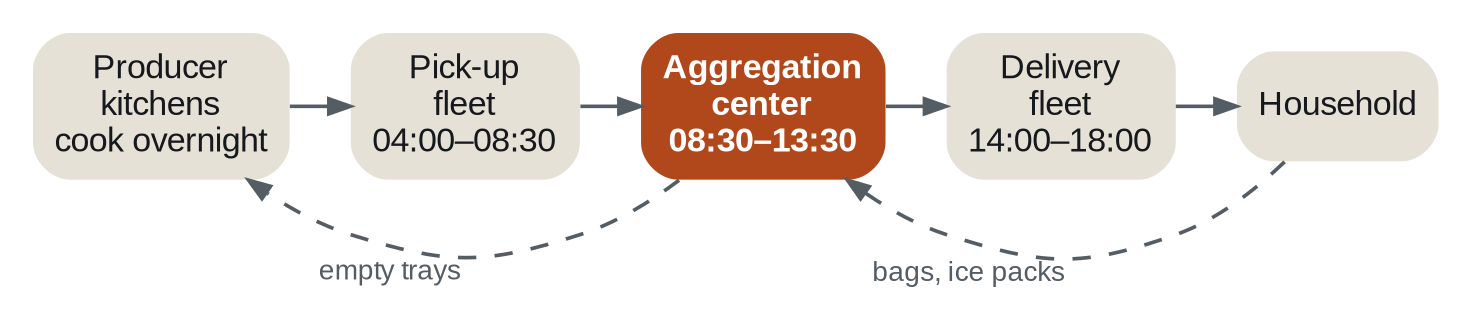
The aggregation center is the subject of this RFP. Youtopia has not yet launched. The producer network and the pick-up and delivery fleets are being stood up alongside this facility, so there is no operating history: every volume in this document is a planning assumption, not a measurement. The first site will be in south Denver, near Centennial, Colorado.
Why this is hard
The difficulty is not volume. Twenty thousand items a day is unremarkable for a distribution center. Three things make it hard together:
- Concurrency. Meals arrive unsorted from many kitchens across many vans (BOD-05), so no household bag can be closed until its last package lands. Every bag is open at once. This drives the physical size of the facility more than throughput does.
- The envelope. Every pod holds 35–40 °F (BOD-20), and the preferred enclosure is a leased shipping container whose walls cannot be cut, so every input and output passes through a four-foot doorway (BOD-33, BOD-34).
- The window. The whole sequence runs between the last inbound van and the first outbound route, in five hours (BOD-12), every day, with no tolerance for a missed departure.
The governing principle: design the pod, not the facility
A site starts with one packing pod, one shared receiving and loading area, and provision for a surge buffer. Capacity grows by adding identical packing pods, roughly once a quarter, to about ten per site. Every pod is fed from the same receiving area, which may have more than one dock door.
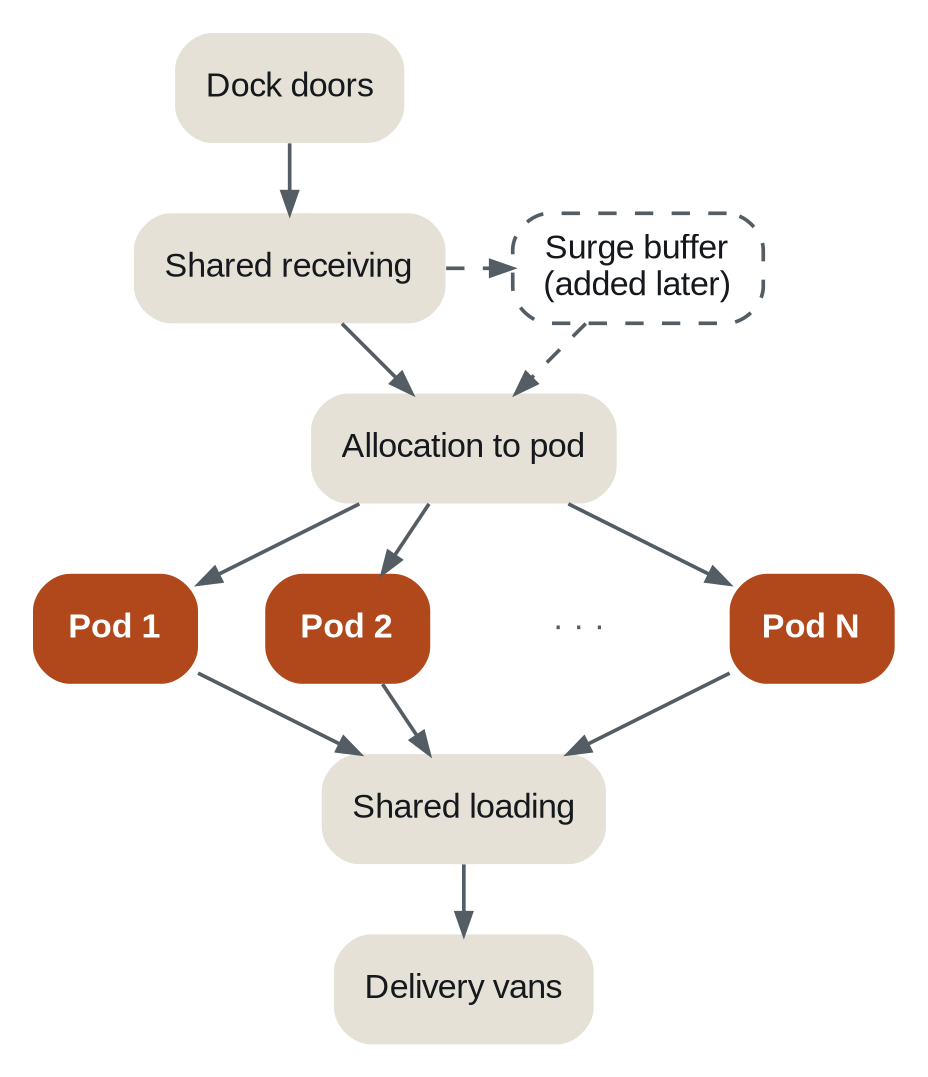
Each site is standalone. Meals are made by local kitchens and nothing ships between sites. Youtopia plans more than 4,000 centers across the US, so the pod will be built tens of thousands of times.
Four consequences govern every work package:
- The pod is a product. Its unit cost, its install procedure and its reliability across tens of thousands of copies matter more than the optimisation of any one site.
- Adding a pod must not re-engineer anything shared. A new pod is installed and commissioned within one non-operating window, with no rework of receiving, sortation or loading beyond configuration. A central sorter with one divert per pod fails this test.
- The marginal cost of pod N matters more than total capex. Pod 1 carries the fixed cost of the site; pods 2 through 10 should be cheap and fast.
- The pod is defined by its capacity and interfaces, not its enclosure. The shipping container is preferred and the purpose-built module remains open (Section 2).
Source documents
This RFP consolidates two internal documents: the 6-Sigma Delivery System functional specification and the Requirements for the Automated Aggregation Center. Both are available to shortlisted bidders under NDA. Where the two disagreed, this RFP states the resolved position and it supersedes both.
4 Scope and how to bid
Scope begins when a pick-up van docks at the aggregation center and ends when a loaded delivery van leaves it.
In scope
| Package | Title | Section |
|---|---|---|
| WP-01 | Receiving and de-tray | 5 |
| WP-02 | Chilled surge buffer | 6 |
| WP-03 | Identification and sortation | 7 |
| WP-04 | Cubbie wall and bag presentation | 8 |
| WP-05 | Pick, tag-strip and place | 9 |
| WP-06 | Bag seal and labelling | 10 |
| WP-07 | Cart build and van load | 11 |
| WP-08 | Controls, integration and data | 12 |
Also in scope across all packages: mechanical and electrical installation, integration with the pod enclosures, the dock interface, the ice-pack system, inspection of returned bags and ice packs, empty-tray stacking and storage, commissioning, operator and maintenance training, spares strategy, and documentation.
This RFP covers the automation inside the Aggregation Center. Youtopia is sourcing the wider ecosystem — compostable packaging, labels and printers, trays, bags and carts, the van fleet and its upfit, routing software and container leasing — through separate engagements set out in its Solution Provider Invitation.
The primary deliverable is a replicable packing-pod design and a site template — the shared receiving, loading, surge and controls a pod plugs into — delivered first at one site. Price and document it so the second site is a copy, not a new project.
Out of scope
- Producer-kitchen equipment, including RFID label printing and application at source.
- The pick-up and delivery fleets, route optimization, and driver systems.
- Bag washing. Youtopia or a separate partner will own it; inspecting returned bags is in scope (Section 13).
- The Youtopia platform. You integrate with it (WP-08); you do not build it.
- Building shell, site works, utility service to the site, and any container leases.
How to bid
State for each work package whether you are bidding as prime, as subcontractor, or not at all.
If you bid a subset, define the physical and data interfaces at each boundary you do not own, in enough detail that another vendor could build to them.
Name the partners you would bring, and say whether you have delivered with them before.
We expect to award either a single prime with named subcontractors, or two to three specialists with Youtopia acting as integrator. Tell us which you are proposing and why it is better for us.
13 Cross-cutting requirements
These apply across work packages, and each traces to the Basis of Design in Section 2. Address them once in your proposal unless a package needs a specific answer.
Throughput and schedule
Size receiving and sortation to the arrival peak, not the daily average. State the peak rate your design sustains and the assumption behind it.
State the latest inbound arrival time your design can absorb and still clear 13:30.
Quote throughput with a stated availability figure (e.g. 20,000 units/day at 95% availability), not a nameplate rate.
Identify the single bottleneck in your design and the cost of removing it.
State the bag count your design assumes and how sensitive your pod count is to it. Youtopia is pre-launch and has no order history, so design to 3,500 bags and show how your pod count moves at 2,500 and at 4,000.
Use four dock doors or fewer, shared by arrivals and departures (BOD-38). Show the unload rate per door that clears the arrival peak and the load rate that clears 13:30.
Enclosure choice
State which enclosure you propose. The shipping container is Youtopia's preference (BOD-33); if you propose the module, show what it buys against the container. You may price both.
Show the pod count your design needs at 20,000 meals per day under the option you propose.
Minimise permitting and ongoing oversight. Describe the permitting path you expect for your enclosure in a typical US jurisdiction, and whether it is treated as equipment or as construction.
If you propose Option B, state the width and length you recommend and why, and whether the module can be relocated between sites.
Container constraints
These apply to the shipping container, the preferred enclosure. They do not apply to a purpose-built module, whose equivalent obligation is an enclosure held within BOD-20, factory-built, and installed within the non-operating window (BOD-14).
Container side walls, roof and floor may not be cut, drilled or penetrated. The containers are leased and must be returned unmodified.
All conveyance into and out of a room passes through a cut-out in one of the two 4 ft front doors. A door carrying a cut-out is permanently fixed shut and no longer functions as a door.
Every cut-out is fitted with a curtain or equivalent that holds the room at 35–40 °F during continuous operation.
Every room must remain serviceable: state how equipment is accessed, removed and replaced given REQ-FAC-001 and REQ-FAC-002.
Equipment inside a room should be installable through a 4 ft doorway without disassembly beyond what one technician can reverse.
With one door consumed by conveyance, a room has a single 4 ft opening left for people, carts, consumables, maintenance and egress. Room layout, throughput and refrigeration are a single coupled problem. Proposals that treat them separately will not survive evaluation.
Transfers between pods — unresolved
This RFP specifies what happens inside a pod and is silent on what happens between pods, which is a real gap rather than an omission we are hiding.
A site with many pods needs a feed to each, crossing the space between them. Those transfers either run through unconditioned warehouse at 60–100 °F, putting every package on the 10-minute clock at the worst moment, or the pods sit inside a larger chilled envelope, which changes the refrigeration load, the cost and most of this section.
Youtopia has not decided. See Q12.
State whether your design requires a chilled envelope around the pods, conditioned transfer enclosures between them, or neither — and give the consequence for REQ-FAC-004 either way.
State the total footprint your design occupies, including the space between pods and any marshalling area, not just the pod count.
Site
Power, compressed air, drainage, floor flatness and clear height at the site are not yet specified, and the site itself is not confirmed. State your requirements and we will confirm feasibility during clarification (Section 20). One related unknown you should price around: the container lease term is not yet settled, so the period over which your installed equipment can remain in place is undefined. If your amortisation assumes a term, state it.
Elevation. The area sits at roughly 5,800–5,900 ft (BOD-36). Air-cooled refrigeration, motors, drives and enclosed electronics are commonly derated above about 3,300 ft because thinner air carries less heat.
Rate refrigeration capacity, motors, drives and electronics enclosures for operation at 6,000 ft, and state the derating you applied.
Winter ambient. The 60–100 °F warehouse range in BOD-24 assumes a conditioned or mild building. An unheated warehouse in the Denver area can fall well below that in winter. Youtopia has not yet decided whether the building will be heated.
State the minimum warehouse ambient temperature your equipment tolerates outside the refrigerated pods, and what changes if the building is unheated.
Level or bridge each cargo van to dock height so tray dollies and bag carts roll on and off without lifting (BOD-38, BOD-39).
Provide dock-to-van weather protection that limits temperature exposure during transfer and fits the high-roof cargo-van fleet (BOD-21).
Product handling
Handle every package shape in BOD-40 on one line without changeover or manual pre-sorting.
Maintain upright orientation throughout. Packages are not watertight and will leak if tipped.
Do not damage or dislodge the tamper-evident tape. A package with disturbed tape is a defect.
Tolerate the hanging tag without snagging, jamming or tearing it prematurely. A tag lost between the sortation read and the pick cell leaves the package unidentifiable and opens a blind segment in the chain of custody. State the tag survival rate your design achieves, and either guarantee it or provide re-identification at the pick cell.
If a packaging change would materially reduce cost or risk, propose it. Packaging is not frozen.
De-stack and singulate from trays carrying 5–9 meals each. Arrangement and orientation on the tray are not yet fixed; state whether a fixed pattern would materially simplify your design, since Youtopia can specify one to its kitchens.
Return empty trays to unrefrigerated staging for collection by the pick-up fleet, tracked by originating kitchen.
Bags are pre-chilled to 35–40 °F at the point of packing.
Dispense ice packs per order, not per bag by default.
How and when bags and ice packs are replenished into packing rooms is undecided. See Section 16.
Bag weight and rigidity, and the liner's closure method, are not yet specified. A pliable film liner will not hold itself open, so presenting the liner open for placement is a design problem for WP-04 and WP-05, not a detail. Youtopia will supply samples (Section 17).
Chain of custody
Every meal package carries a machine-readable identity from production to the household door, and every handoff reconciles a physical read against an expected inventory produced by the previous step.
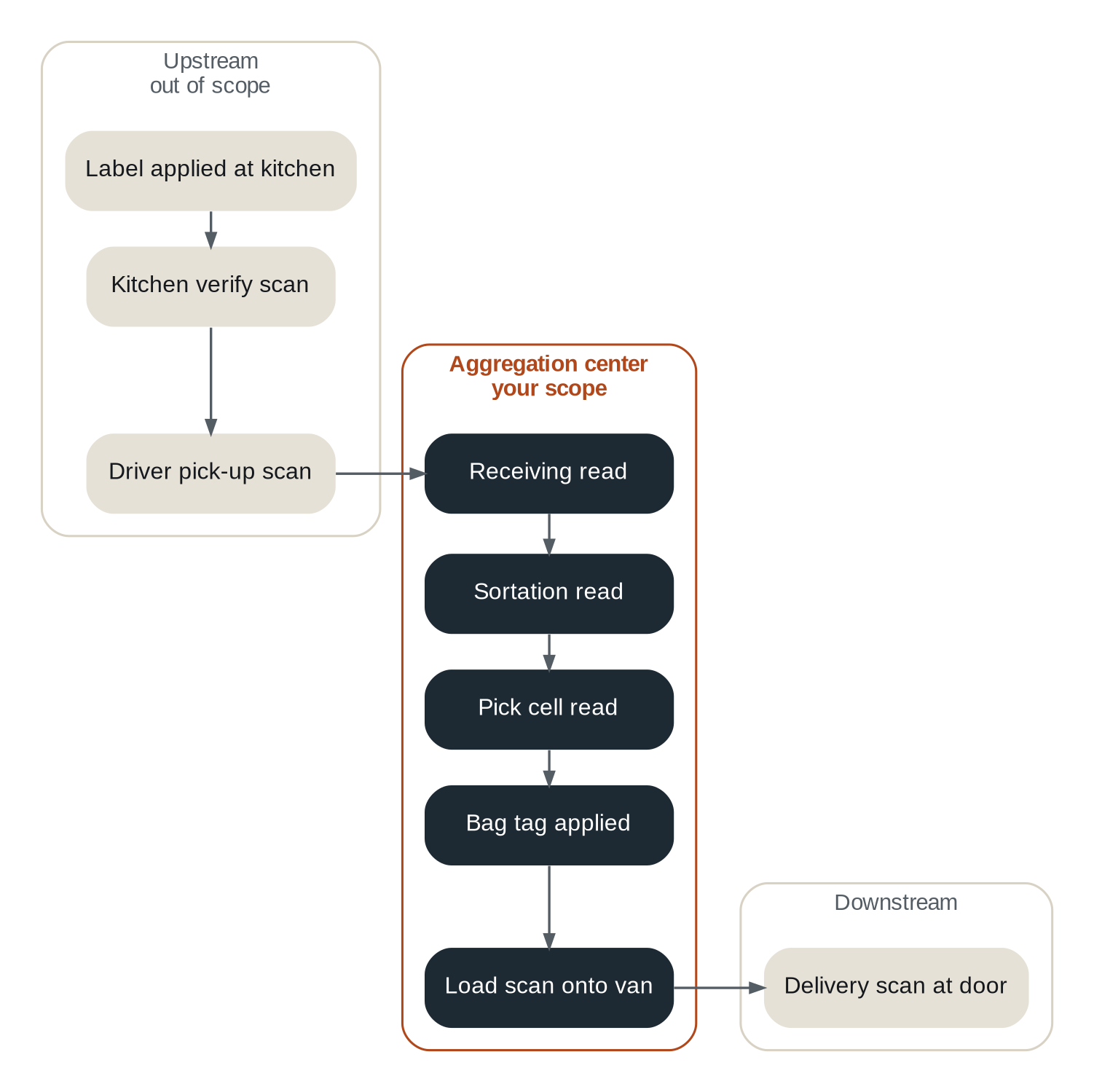
Steps upstream of receiving happen at the kitchens and on the pick-up fleet and are out of scope. Every scan inside the aggregation center is yours.
The RFID tag is an identifier only. Nothing is written back to the tag at any point in the facility. All state lives in the Youtopia platform and is retrieved by lookup.
Every scan event reconciles against an expected inventory supplied by Youtopia for that step.
A discrepancy — an expected package not read, or an unexpected package read — raises an exception event at the step where it occurred, delivered to Youtopia within 2 seconds of detection. "Real time" is not a specification; if 2 seconds is the wrong number for your architecture, propose one and justify it.
Youtopia owns exception resolution. Your obligation is detection and propagation: the information must flow downstream fast enough for us to act before the bag closes.
Reads must be individually attributable to a single package. A bulk count that confirms quantity but not identity does not satisfy this requirement.
The hanging RFID tag is removed between identification and final bag placement, at the point your design defines (BOD-52). Tags are single-use and are not reused.
Every package should carry a complete, queryable event history: which room, which cell, which cubbie, what time.
Bag contents are fixed at least 24 hours ahead and routes are assigned the morning of (BOD-55). This matters for cubbie allocation: the household-to-cubbie binding can be pre-staged the night before, while anything printed with a route or stop cannot be produced until the morning.
Pre-staging is only worth building if the plan holds. Consumers cancel, change contents and change addresses, and Youtopia has not yet set a change freeze point.
State the latest point in your process at which a bag's contents can change without manual intervention, and what happens to a pre-staged cubbie when a plan changes after that point. Youtopia will set its customer-facing change cut-off to match a workable answer.
A household may receive several bags. Youtopia's bag plan specifies which meals go in which bag. A household's bags are tracked as a group, loaded to the same stop on the same van, and reconciled together: a household is complete only when all of its bags are sealed and loaded.
A household's bags need not be packed in the same pod. If your design spreads them across pods, show how they are re-united before loading.
Thermal
All equipment operates continuously at 35–40 °F and 90%+ relative humidity with condensation present.
Equipment must not add heat load that the pod's cooling unit cannot absorb. State your heat output per pod.
No condensation may drip onto food packages from any part of your equipment.
Tolerate the daily transition between a chilled room and a 60–100 °F warehouse without fogging, icing or electronics failure.
Demonstrate compliance with the exposure limit (BOD-21) at every transfer in your design. Compliance is measured as elapsed time outside a space held at 35–40 °F, not as package core temperature. We know that is conservative: propose a product-temperature criterion instead, with a measurement point and a validation method, under Q11.
Food safety and sanitation
All food-contact and food-adjacent surfaces are food-grade, cleanable and corrosion-resistant.
Equipment is designed for washdown, or for a documented dry-clean regime you specify. State which, and the IP rating of every enclosure.
State the daily sanitation time your design requires and where it falls in the 24-hour cycle. Under Option A, container floors were not designed for drainage; if your regime needs drainage, say so now.
No lubricant, fastener, or fragment may enter the food stream. Document your foreign-object controls.
Design to a recognised standard for food equipment hygiene. Name it.
Regulatory
Youtopia holds the food facility registration and owns regulatory compliance for the operation. Your obligation is to build equipment and systems that let us meet it.
State how your design supports FDA FSMA record-keeping, including the traceability and lot-linking obligations under the Food Traceability Rule, given that every package already carries a unique identifier.
Support a recall: given a lot, producer or date range, the system must identify every affected bag and its delivery address. State the query latency.
Describe how your design handles allergen cross-contact risk on shared conveyance and grippers.
Identify the HACCP critical control points your equipment touches and the monitoring records it produces.
Provide a temperature record per package or per bag sufficient to demonstrate cold-chain compliance to an auditor.
The sanitation regime itself is Youtopia's decision, not yours. REQ-XCT-012 asks what your equipment requires; we will reconcile that against our QA function and the local health authority and confirm the window during clarification.
Worker safety
Comply with OSHA and applicable machine-safety standards for collaborative and guarded operation.
Safe human access for clearing jams and for maintenance inside a pod — under Option A, a 7 ft 6 in room with one usable exit.
Emergency stop coverage and egress that remains valid with a conveyor occupying one doorway.
Account for cold-work exposure limits for any human operator inside a packing room.
Utilities and installation
State power, air, network and drainage requirements per room and in total.
All equipment installs through the pod's doorway and is removable the same way — under Option A, a 4 ft doorway (REQ-FAC-007).
Under Option A, installation must not modify the container structure (REQ-FAC-001). Describe your mounting method.
Reliability and maintainability
State MTBF and MTTR for each major subsystem.
Any single point of failure whose loss stops the 13:30 departure must be identified, with the mitigation.
Spares strategy, recommended on-site inventory, and lead times.
Remote diagnostics and support model, including response times.
Training for Youtopia operators and maintainers, with the curriculum and duration.
Ice packs and returns
Ice packs and returned bags are in scope (BOD-43, BOD-45). Washing returned bags is not.
Freeze and stage up to 6,000 reusable 2.5 lb ice packs a day on staggered first-in, first-out cycles, on carts of 100. State BTU capacity, airflow, recovery time and footprint.
Inspect returned ice packs for contamination, cracks and leaks, and remove failures from service.
Sanitize returned ice packs food-safely, without leaving an unsafe or objectionable surface inside a delivery bag.
Track ice-pack inventory through inspection, sanitization, freezing and packing, with live availability and demand by packing room.
Inspect returned delivery bags inside and out for cleanliness, tears, staining and branding damage, and sort them into good, rework and retire.
Design rolling carts that hold 100 ice packs and balance freezing performance, ergonomic handling and safe movement through the facility.
14 Performance, acceptance and warranty
The accuracy target is BOD-60: no defective bag leaves the building. We do not expect zero faults; we expect every fault detected and flagged before the van doors close.
This is a detection requirement, not a first-pass-yield requirement. It is the reason the chain of custody in Section 13 exists. A design that achieves 99.9% pick accuracy and catches every one of the remaining errors is acceptable. A design that achieves 99.99% and lets the rest through silently is not.
Defect definitions
| Term | Definition |
|---|---|
| Fault | A package placed in the wrong bag, omitted, damaged, or unidentified at any step. |
| Detected fault | A fault raised as an exception before its bag is sealed. |
| Escape | A fault present in a bag that left the building. |
| Defective bag | A bag delivered with wrong, missing, damaged or extra contents. |
State your first-pass fault rate per work package, measured, with the reference installation it comes from.
State your detection rate — the proportion of faults your design catches before seal — and how it is measured.
State the escape rate you will warrant contractually, and what remedy applies when you exceed it.
Distinguish read faults from placement faults from mechanical faults. They have different causes and different remedies.
Propose the measurement method itself. We would rather adopt a metric you can actually instrument than impose one you cannot.
Availability
State guaranteed availability across the five-hour window, and the definition you are using.
Describe the recovery path when a cell or room fails at 11:00 with 13:30 fixed. Manual fallback, redundancy, re-routing — show the plan and the throughput it preserves.
State the maximum outage your design can absorb and still make the 13:30 departure.
Acceptance
| Stage | What it proves | When |
|---|---|---|
| Design review | The concept meets the requirements in this RFP | Post-award |
| Factory acceptance test | Subsystems meet rate and accuracy at your site | Pre-shipment |
| Site acceptance test | Installed system meets rate and accuracy at ours | Post-install |
| Reliability run | Sustained performance over consecutive production days | Pre-handover |
Propose FAT and SAT protocols including the rate, accuracy and duration criteria you will be measured against.
Propose a reliability run: consecutive days at full volume before Youtopia accepts the system. State the duration.
State warranty period, coverage and response times.
Propose how payment milestones tie to these acceptance stages.
15 Ramp, phasing and replication
The same design must work at one pod and at full build-out (BOD-30 to BOD-35). Ten pods is the reference point for pricing, so proposals can be compared; your design may need more or fewer (Section 2). Volume grows by adding identical pods to a running site, roughly once a quarter, never by replacing the system. This section turns the principle in Section 3 into requirements.
Describe your design at three points: one pod (the minimum viable site), four pods, and the full site at 20,000 meals per day. At each, give pod count, meals per day, cubbie count, pick-cell count, and capital cost split into fixed site cost and per-pod cost.
Capacity is added in pod-sized increments. Every packing pod at a site is identical, and adding one requires no redesign and no replacement of installed equipment.
State the minimum viable first phase — the smallest deployment that proves the concept in production.
Adding a pod is non-disruptive: it is installed, integrated and commissioned without stopping production, or at most within one non-operating window, with no rework of shared receiving, sortation, loading or controls beyond configuration. The site runs seven days a week, so there is no weekend: the non-operating window is the overnight gap from the 13:30 departure to 08:30 receiving, roughly 19 hours, shared with sanitation, bag returns and restocking. State how much of it a pod install consumes.
Identify what is inherently fixed-cost regardless of volume, so we understand the economics of the early phases.
State lead time from order to commissioned capacity for one additional pod.
State the marginal cost of pod 2, pod 5 and pod 10. We expect pod 1 to carry most of the fixed site cost and later pods to be substantially cheaper. A proposal where pod 10 costs nearly what pod 1 does is a bespoke build presented as modular, and will be scored accordingly.
The minimum viable site is one packing pod, one receiving and loading area, and provision for a surge buffer. The surge buffer need not be installed at pod 1, but the receiving architecture must accept one later without rework. State the pod count at which your design first needs it.
Provide a pod install runbook: the sequence, crew size, duration and commissioning tests for adding one pod to a running site. Youtopia will execute this hundreds of times a year across the network.
Youtopia is pre-launch and has no operating history, so pod 1 is also the instrument that sizes pods 2 through 10. It must record, in a form Youtopia can analyse: order and bag sizes, arrival time by van and by producer, time from a bag's first package to its last, cubbie occupancy across the window, and every exception. The facility's design point of 20,000 meals a day is a forecast; this data is how it gets tested before capital is committed to the next pod.
Replication
Youtopia intends to build more than 4,000 Aggregation Centers across the US, serving a target market of more than 42 million consumers. Each site is standalone, since meals are made by local kitchens and nothing ships between sites, so the pod and the site template will each be built many times over — plausibly tens of thousands of pods across the network.
State how much of your design is a product versus a bespoke build, and how unit cost changes across the second, third and fifth deployment.
Describe what changes when the site, the pod count or the local labour market differs.
If you would price differently for a multi-site programme than for one facility, say so and show both.
Phasing preference
We would rather run a small automated facility early and learn from it than wait for a complete 20,000-meal system. Proposals that front-load risk reduction — an RF trial, a single pick cell, one instrumented packing room — will be viewed favourably even where total cost is higher.
17 What Youtopia provides
We will not make you guess at things we can hand you.
Available on request, now
- Sample compostable meal packages across the current range, filled to representative weight.
- Sample trays, dollies, insulated bags, liners and ice packs.
- Current RFID tags and labels as used at producer kitchens.
- The 6-Sigma Delivery System functional specification and the Requirements for the Automated Aggregation Center, under NDA.
- Container drawings and, for Option A, the lease terms governing modification.
RF trial — available before you bid
REQ-WP3-010 asks for measured RFID performance in a comparable enclosure, and we recognise that most firms will not hold that data for this specific environment. So the RF trial is available before proposals are due, not only to shortlisted bidders.
Youtopia will provide a representative refrigerated container, live tags, real packages at realistic density, and a half-day session. Request it with your intent to bid. We would rather fund several trials and receive real numbers than collect a stack of datasheet figures and discover the truth after award.
Available to shortlisted bidders
- Site access for survey and measurement.
- An RF test session in a representative refrigerated container with live tags and packages.
- Youtopia's planning assumptions for order size, assortment and producer mix. Youtopia is pre-launch, so these are forecasts, not operating data.
- API documentation and a sandbox environment for WP-08 integration planning.
- Access to the Youtopia team designing the producer network and fleet operations.
Youtopia's obligations during delivery
- Enclosure procurement (container or module), placement, power and refrigeration commissioning.
- Site preparation, including any drainage and floor work your design requires.
- Platform-side API development and the expected-inventory feeds.
- Producer-kitchen labelling process and its compliance.
- Bag washing and consumable inventory.
- Operator staffing and management.
Data we do not yet have
We would rather tell you than let you discover it in week three. See Appendix D for the full list, which includes the inbound arrival curve, the producer-per-order distribution that determines peak bag concurrency, and the building itself.
Some will be closed before contract award; others, such as the producer mix, can only be measured once pod 1 is running (REQ-RMP-013). If your design is sensitive to one of them, tell us in your proposal.
18 Proposal requirements
Submit the following. Sections A through H are mandatory; a proposal missing any of them will not be scored.
Two bid routes
We are aware that this document contains seventeen open questions, a list of acknowledged data gaps, no selected building and no budget envelope, and that asking for firm fixed pricing against it would reward whoever loads the least contingency and recovers through change orders. So there are two acceptable routes.
Route A — full proposal. Price the build as described below, stating every assumption your price depends on and the contingency you carry.
Route B — study first. Propose a paid, fixed-fee engineering study of 8–16 weeks that closes the questions your design is most sensitive to, with the build priced at its conclusion. A credible Route B bid is not treated as weaker than Route A. Tell us which route you are taking in Section A of your response.
A Route B proposal should say what the study resolves, what it costs, how long it takes, what you deliver at the end, and whether the fee is credited against the build if we proceed with you.
| # | Section | Limit |
|---|---|---|
| A | Executive summary — what you are bidding and why you | 2 pages |
| B | Technical approach, per work package bid | 4 pages per package |
| C | Compliance matrix — every requirement ID with a code and a note | No limit |
| D | Answers to Q1–Q17 (Section 16) | 4 pages |
| E | Performance commitments — rate, accuracy, availability, with evidence | 3 pages |
| F | References — three comparable installations | 3 pages |
| G | Commercial — pricing, schedule, terms | No limit |
| H | Risks — your top five, with mitigations | 2 pages |
Technical approach (Section B) must include
- Concept layout drawing showing pod count, room functions and material flow.
- The enclosure you propose and, if it is not the preferred container, what it buys (REQ-FAC-020).
- Throughput model with stated assumptions, showing you clear 13:30.
- Equipment list by major subsystem, with make and model where you are integrating rather than building.
- Interface definitions at every boundary you do not own.
- What is proven in an existing installation versus what is new development for Youtopia. Be candid; we will find out either way.
Performance commitments (Section E) must include
- Measured rate and accuracy from a named or NDA-described reference site, not a nameplate figure.
- Specifically for WP-03 bidders: a measured RFID read and mis-read rate from a metal-enclosed refrigerated environment (REQ-WP3-010).
- What you will warrant contractually, and the remedy if you miss.
References (Section F) must include
For each of three installations: the client (or a description under NDA), scope, volume, go-live date, whether it hit its committed rate on schedule, and a contact we may call.
At least one reference must involve cold-chain or food handling. At least one must involve item-level identification at comparable volume.
Commercial (Section G) must include
- Capital cost by work package, split into a fixed site cost and a per-pod unit price, at the pod counts in REQ-RMP-001 — plus the marginal cost of pods 2, 5 and 10 (REQ-RMP-007) and your price for a second site built from the same template.
- Engineering, installation, commissioning and training, priced separately.
- Annual support, spares and software licensing.
- Payment milestones tied to the acceptance stages in Section 14.
- Schedule from award to commissioned capacity, with the critical path shown.
- Price validity period and the assumptions your price depends on.
Format
PDF, English, US customary or metric units. One file per section, or one combined file with a navigable table of contents. Page limits apply to substantive content; drawings and the compliance matrix are excluded.
19 Evaluation criteria
Proposals are scored out of 100. Price is weighted at 20%, which is deliberate: the cheapest system that misses 13:30 is worth nothing.
| Criterion | Weight | What earns a high score |
|---|---|---|
| Technical credibility | 20 | Evidence from comparable installations; measured figures, not nameplate; honest about what is new development |
| Modularity and unit economics | 15 | Identical pods; low marginal cost of pod N; non-disruptive install; a template a second site can copy |
| Handling the hard constraints | 15 | A convincing answer to bag concurrency, the enclosure choice and the RF environment |
| Engineering judgment | 15 | Quality of answers to Q1–Q17; willingness to challenge our assumptions with reasoning |
| Price | 20 | Fixed site cost plus per-pod unit price across a ten-pod build-out, not headline capex |
| Schedule | 5 | Credible path to a first pod in production |
| Integration and support | 10 | API maturity, support model, and how you work alongside another vendor |
What scores well
- Telling us a requirement is wrong, and showing the analysis.
- A measured number with its conditions stated, even when the number is unflattering.
- A phased proposal that reduces risk early rather than one that de-risks on paper.
- Naming what you cannot do and who should do it instead.
What scores badly
- Nameplate throughput with no availability assumption.
- Datasheet RFID read rates presented as measured performance.
- Compliance claimed against every requirement with no deviations. Nobody complies with all of this.
- A proposal that ignores Section 16.
Disqualifiers
A proposal will not be scored if it: claims a zero-defect or zero-escape rate without stating how it is measured and what it is warranted at; proposes cutting a leased container's structure; omits the compliance matrix; or provides no reference installation for a bid work package.
To be explicit, since an earlier draft of this document was ambiguous: accepting the target in Section 14 is not a disqualifier. Accepting it without a measurement method is.
Process
Shortlisted bidders present in person or by video, walk their layout, and answer follow-ups. We will also ask to speak to the engineers who would run the project, not only the sales team. Expect a site visit and, for WP-03 bidders, an RF trial before award.
20 Commercial terms, process and timeline Draft, subject to change
Draft — subject to change. The commercial terms in this section have not completed legal review. They show the positions Youtopia expects to take and may change before proposals are invited.
Timeline
Dates will be confirmed and circulated to every bidder who registers intent to bid.
| Milestone | Date |
|---|---|
| RFP issued | TBD |
| Intent to bid due | TBD |
| Clarification questions due | TBD |
| Youtopia responses circulated to all bidders | TBD |
| Site visits, sample collection and RF trials | TBD |
| Proposals due | TBD |
| Shortlist notified | TBD |
| Presentations | TBD |
| Preferred bidder selected | TBD |
| Contract award | TBD |
Clarifications
Submit questions in writing by the date above. Answers go to every bidder without attributing the question. We would rather answer a hard question once, publicly, than let a bidder guess.
Commercial terms
Prices held valid for 90 days from submission.
State all assumptions your price depends on, and what would change it.
State your position on Youtopia owning or licensing the controls software (WP-08), and what happens to it if the relationship ends.
Confirm you can accept payment milestones tied to acceptance rather than to delivery.
State your position on liquidated damages for missed throughput or schedule.
State your proposed ownership position on the pod design and the site template. Youtopia has not decided whether to own the design outright, license it exclusively, or buy units at a unit price, and will evaluate all three (Q17). At tens of thousands of pods across the network this is likely worth more than any single build contract. State specifically whether you would sell an equivalent pod to a competitor, and on what terms you would agree not to.
Liability, insurance and governance
State your position on a liquidated damages regime for missed throughput or schedule, including the cap you would require. We do not expect uncapped exposure and will not ask for it.
State your insurance coverage and limits, and whether you can provide a performance bond.
State your requirements for documentation deliverables — CAD or BIM format, as-built standard, and O&M manual scope — or confirm you will work to a standard Youtopia nominates.
State the decision turnaround you need from Youtopia to hold your schedule. With seventeen open questions, a slow client decision loop is a real schedule risk and we would rather commit to a service level than discover we are the bottleneck.
On Youtopia as integrator
Section 4 contemplates Youtopia integrating two or three specialists. Youtopia is a nutrition software company, and multi-vendor materials-handling integration is a discipline we do not have in-house.
If you believe the multi-vendor model puts the programme at risk, say so, and state whether you would take prime responsibility or recommend we appoint an owner's engineer. This will not count against a bidder who raises it.
Confidentiality
This RFP is published openly. Bidders execute a mutual NDA before receiving source specifications, order data or site access. Youtopia will not share one bidder's technical approach with another.
Youtopia reserves the right to award in part, to award to multiple vendors, to re-scope, or not to award at all. This RFP is not an offer and creates no obligation to contract.
Contact
All correspondence to a single point, by email only:
Paul White, Head of Producers, Youtopia
Paul.White@youtopia.com
To meet Paul White, Ken Neumann (CEO) and Trevor Eulenbach together, use the booking link on the vendor site at operations.youtopia.com. Please keep all other contact about this RFP to Paul.
21 Appendices
Appendix A — How to read this document
Every requirement carries an ID. Respond to each one individually in your compliance matrix (Section 18). Basis of Design items carry a status instead of an obligation level (Section 2); cite them by ID wherever your response depends on one.
ID format: Basis of Design items are BOD-<NN>; requirements are REQ-<AREA>-<NNN>. Areas are OPS (operating), FAC (facility), PKG (packaging), COC (chain of custody), WP1–WP8 (work packages), XCT (cross-cutting), PRF (performance), RMP (ramp).
Obligation levels:
| Level | Meaning | If you cannot meet it |
|---|---|---|
| MUST | Binding. A design that fails it is not viable. | Say so explicitly and propose an alternative, or do not bid that package. |
| SHOULD | Strongly preferred. We will trade it against cost or schedule. | Explain the trade and what we get instead. |
| MAY | Optional. Tells you where we are flexible. | No response needed. |
| TBD | We have not decided. Section 16 asks for your recommendation. | Answer in Section 16. |
Compliance codes for the matrix: C (comply as written), CD (comply with deviation — describe it), CE (comply by exception — requires something from Youtopia), NC (not compliant), NB (not bid — outside your scope).
Two conventions worth flagging. Units are US customary, because the facility, the containers and the packaging are all specified that way. Temperatures are Fahrenheit. We will accept metric responses without penalty. Where this document gives a derived figure — a rate per minute, a concurrency count — the derivation is shown. If you think the arithmetic or the assumption behind it is wrong, say so. Several of these numbers drive the entire capital cost.
Appendix B — Requirement index
| Prefix | Area | Section |
|---|---|---|
| BOD | Basis of Design | 2 |
| REQ-OPS | Bidding, throughput, open questions and commercial | 4, 13, 16, 20 |
| REQ-FAC | Enclosure and site | 13 |
| REQ-PKG | Product handling | 13 |
| REQ-COC | Chain of custody | 13 |
| REQ-WP1 | Receiving and de-tray | 5 |
| REQ-WP2 | Chilled surge buffer | 6 |
| REQ-WP3 | Identification and sortation | 7 |
| REQ-WP4 | Cubbie wall and bag presentation | 8 |
| REQ-WP5 | Pick, tag-strip and place | 9 |
| REQ-WP6 | Bag seal and labelling | 10 |
| REQ-WP7 | Cart build and van load | 11 |
| REQ-WP8 | Controls, integration and data | 12 |
| REQ-XCT | Cross-cutting | 13 |
| REQ-PRF | Performance and acceptance | 14 |
| REQ-RMP | Ramp and replication | 15 |
Appendix C — Glossary
| Term | Meaning |
|---|---|
| AC | Aggregation Center — the facility this RFP covers |
| Bag | The insulated delivery unit, typically 3–10 meal packages, up to 14 lb including ice packs; a household may receive several |
| Bag tag | The label applied at seal, carrying consumer and route data |
| Basis of Design (BoD) | Section 2: the single set of facts every design must meet, each with a status |
| Cubbie | A single bag position in the packing-room wall |
| Escape | A fault that left the building undetected |
| HGK | Producer kitchen — an independent establishment that cooks meals |
| Liner | The pliable film bag inside the insulated bag, closed with a tamper-evident closure |
| Meal package | One individually packaged meal, one of 13 SKUs |
| Packing room | A packing pod: one identical, self-contained refrigerated unit with a cubbie wall and pick cells, container or purpose-built. The unit of capacity. |
| Route cart | The wheeled unit holding bags in delivery stop order |
| Tray | Reusable stackable tray, about 22 × 26.5 in, carrying 5–9 meals from a kitchen |
| WMS | Warehouse management system — the controls, tracking and orchestration layer of WP-08 |
Appendix D — Known data gaps
The status of each known gap. Resolved rows stay so bidders can see what changed. Open rows will be closed before award where possible, and otherwise by pod 1 (REQ-RMP-013).
| Gap | Affects | Status |
|---|---|---|
| Producer-per-order distribution | WP-04 peak bag concurrency — the largest cost driver | No data — pre-launch; pod 1 will measure it (REQ-RMP-013) |
| Inbound unload curve across 08:30–09:30 | WP-01, WP-02 sizing; the 222 vs 333 per minute question | Assumption only (Q9) |
| Packages per tray, and whether trays are patterned | WP-01 sizing, dock dwell | Resolved: 5–9 per tray; arrangement open |
| Bag and liner dimensions, weight, closure type | WP-04, WP-05, WP-06 | Resolved: 16 × 10 × 14 in, up to 14 lb including ice packs, film liner; insertion timing and closure open |
| Building within the south Denver / Centennial market; floor plan, clear height, utilities, drainage, heating | All packages | Not confirmed |
| Operating days per week and maintenance window | Redundancy cost across all packages | Resolved: seven days a week; overnight window only |
| Container lease term | Equipment amortisation, REQ-FAC-001 | Not settled (Option A only) |
| Sanitation window and regime | WP-01 through WP-07 | Youtopia QA decision, pending |
| Ice packs per bag and share of bags | WP-05, ice-pack system | About two a bag, up to 6,000 a day; per-order rate not yet known |
| Container interior length | Cubbies per pod | Resolved: 36 ft |
| Packaging material | Grip and suction design | Resolved: compostable fiber or plant-based PLA; no petroleum-based plastics |
| Current state — manual volume today | Phasing, REQ-RMP-003 | Resolved: pre-launch, no operating history |
| Budget envelope and target go-live | Commercial | Not set |
| Regulatory sign-off authority and recall SLA | REQ-XCT-015 to 019 | Youtopia to confirm |
| Order-size distribution (meals per household per delivery) | Bag count, and so pod count, via multi-bag splits | No data — pre-launch; planning assumption is mostly 6+ items |
| Enclosure choice and width | Pod count, aisle feasibility, permitting path | Container preferred; module open (Q14) |
| Pod design ownership | Commercial terms, exclusivity | Open (Q17) |
The first row is the one that matters most. Peak concurrent open bags drives pod count, which drives almost everything else. If it turns out that a material share of households draw from a single kitchen on a single van, the facility could be materially smaller than this document assumes.
Tell what you can do
Your email app opens with everything filled in. Nothing is sent until you press send, and you can attach a capability statement or reference sheet before you do.
Your picks
Nothing picked yet. Mark work packages or scope areas above, or just tell us about your company.
We can do this
Interested
Meet us
leads conversations with solution providers. Start here for anything about the Aggregation Center.
Book 30 minutes with all three of us
- ,
- Ken Neumann,
- Trevor Eulenbach,
A Teams call. Pick any time that's open; it lands on all three calendars.
What happens next
- Send your picks or book a time.
- We talk through fit, comparable installations and your approach.
- Providers who fit are invited to respond to the RFP. Source specifications, order data and site access follow under a mutual NDA.
Questions
Is this an RFP?
Not yet. The draft RFP is published so you can judge fit and shape your thinking. Providers who fit will be invited to respond formally; dates are still to be confirmed.
Can we take on just one piece?
Yes. Engage on one specialty, several related workstreams, or the whole system. We'd rather work with excellent specialists than one adequate prime.
Are you looking for an integrator?
Yes. Multi-vendor materials-handling integration is not something we have in-house. If you'd take prime responsibility, tell us.
Do we need an NDA to read this?
No. Everything on this page is public. Source specifications, order data and site access require a mutual NDA.
Where is the first center?
Denver, Colorado. Rate equipment for about 6,000 ft of elevation.
Who owns the design?
Still open: own outright, license exclusively, or buy units. It's in Section 20, which is a draft and subject to change.